Thursday, December 30, 2021

Dracula (Audible edition) by Bram Stoker

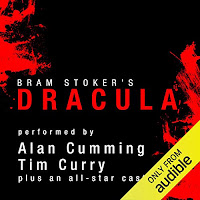
As part of my continued campaign to revisit classics, I chose to dip into this perennial Gothic favourite by giving the Audible edition of Bram Stoker's Dracula a spin. Then again, who can go wrong with this wonderful cast, including Alan Cummings, Tim Curry, and the late veteran audiobook reader Katy Kellgren, among others. 

I think it's safe to say that most of us have seen the movies and series inspired by Stoker's work, but so far few of them have been able to capture the depth and breadth of the source material. I first read Dracula in high school, and I admit freely that many of the subtler undercurrents went way over my head. Also, having just gone through Mary Shelley's Frankenstein, and with the work fresh in my mind, I can compare these two classics within the Gothic genre better. Each is quite a different beast, and while there is, in my opinion, more emotional and philosophical weight to Shelley's writing, there is, nonetheless, an astonishing attention to detail in Stoker's work.

Perhaps what makes this edition all the more special is the way that it cleaves to its epistolary nature by employing different readers to take on the letters and diary entries of the characters, imbuing each with their particular flavour and tone. In that way, Audible Studios has done well in their creative decisions. It's easy to close your eyes and sink into the narrative as the setting becomes fully tactile. 

Dracula is very much a product of its time, in which women are placed upon a delicate pedestal, and yet, if one is able to look deeper, it becomes apparent that Mina Harker is indeed one of the more heroic characters within this story. Her resilience and ingenuity is easily overlooked by Jonathan, Van Helsing and the others, and yet without her capable, stalwart assistance, I'm certain they would never have overcome the great evil that nearly overwhelmed them. The fact that they sought to shelter her from the dangers posed by the count nearly proved their undoing. 

This edition is slick, eminently listenable, and if you've yet to hit up the source material behind so much of our modern horror media, I highly recommend this audiobook.

Saturday, December 18, 2021

Ancestral by Charlie Human

Charlie Human brings readers stories with bite, action-packed while still poking sticks at aspects of South African society and the world at large with a flash of the absurd – and Ancestral is no different. If you're looking for a tale with a slowly unfolding pace, then this one is not for you. We are dropped right in the middle of the action, with erstwhile soldier Clementine Khoza on a mission to retrieve her kidnapped son, Drew.


But this is no straightforward retrieval quest. The world in which Clementine immerses herself is dark and dysfunctional, the once-utopian, exclusive gated neighbourhood of Welcome Shade – now overrun by gangs. Not the kind of territory for the faint of heart. But then again, Clementine is a hard woman, made so by the upbringing of her strict Zulu grandfather who taught her the martial art of stick-fighting and the years of conflict in which she has been embroiled over the years.

As she travels further into uncertain, dangerous territory, she uncovers a far more sinister threat to mankind that is inextricably linked to her very blood and heritage, and she teams up with unlikely, unasked-for allies without whom she would not stand a gnat's chance in a windstorm for survival. Whether she likes it or not (and trust me, she doesn't) Clementine is a chosen one – a last bastion of hope for our species.

All in all, this is a fast-paced read – so much so that I sometimes felt the writing was a little rushed in places and could have used a little more depth. But then this might be down to my own personal preference, so if you disagree, don't mind me. There were moments where I wondered exactly how long a drone's batteries can last after heavy use without a recharge, but I won't spoil the story by worrying overly much about these sorts of details. 

I do think this is the sort of tale that will no doubt appeal to folks who enjoy a good manga. Ancestral is fun, charges along at a breakneck pace, and offers a roller coaster ride of one untenable situation to the next, garnished with a healthy dollop of cosmic, insectoid horror. 

Monday, November 29, 2021

A Kind of Magic: Making the Original Highlander by Jonathan Melville

Way, way back, in that delirious summer vacation between my primary and high school years, I watched a film that I'd best describe as pivotal in my development as an author and musician. The original 1986 Highlander, starring Christopher Lambert, Sean Connery, and Clancy Brown, lodged itself in my imagination, and taught me two things: fantasy is my calling, and Queen's music is the best.


In A Kind of Magic: Making the Original Highlander, Jonathan Melville sets about the ambitious endeavour of chronicling the making of the film that sparked a cinema and TV franchise, accompanied by tie-in fiction and card games that have garnered a small but rabid fan following over the intervening decades.

It can be argued that the original Highlander has its flaws, yet for those of us who've comfort-watched it more than a score of times (yes, I'm one of those people who can say the lines before the actors even open their mouths), it's an immortal classic that provides a visual feast thanks to director Russell Mulcahy's savvy eye and the creative team that had his back. And of course, let's not forget the killer soundtrack developed by British rock band Queen and composer Michael Kamen.

Melville's legwork and interviewing skills result in deep dive into the process of how a film comes together, from the writing to pre-production, filming, and eventual distribution, as well as life beyond the big screen. For all the things that did go wrong (as it inevitably does in the production of any film), so much somehow came right. We get the good, the bad, and the ugly, as well as a fascinating glimpse behind the scenes into the unique pressures in the industry back in the 1980s. Knowing what I do of contemporary filmmaking thanks to my own involvement in the industry, exactly how cast and crew managed back then absolutely blows my mind.

I savoured every chapter of this book, and value it as an important artefact and time capsule of sorts to both entertain and inform those of us who have enjoyed this fantasy cult classic that's part-romance, part-historical adventure epic. This is one for the fans.


Friday, October 22, 2021

The Ape's Wife and Other Stories by Caitlín R Kiernan

The Ape's Wife and Other Stories by Caitlín R Kiernan has been sitting on my Kindle app for far too long, and I'm glad that I've finally gotten around to reading it – especially since some folks have drawn parallels between her writing and mine (why thank you). First off, as with all short story anthologies, whether single or multiple authors, this is a mixed bag. I gelled with some and not with others, and to go into a deep dive about each story is going to go beyond the scope of this review.


A diverse range of stories is showcased here, from steampunk-infused and somewhat Lovecraftian to plain old weird and re-envisionings of Beowulf told from a queer feminist perspective. I'm not going to go exhaustively into each, as I feel that will ruin the magic and mystery. What I will say is that if you're expecting neat, tidy endings with satisfying twists and likeable characters, maybe step away from this collection and go read Somerset Maugham or Saki.

Kiernan's prose is textured and tactile, and her tales often left me feeling out of sorts and scratchy behind the eyes – all hallmarks of good storytelling. This is not a book I'd recommend for anyone who's looking for comfort reading. I'd hazard to say that each story encapsulates a mood and a setting, and emphasis is mostly placed on emotion and engaging the senses to detriment of a tidy plot. And if that is what floats your boat, then hey, this will work for you. Kiernan doesn't shy away from characters who often maintain objectionable outlooks and opinions, so if you're easily triggered by casual racism and sexism, perhaps step away from this book, too. I feel I must add that some readers appear to be incapable of separating the author from their characters. [le sigh]

As a publishing professional, I feel I must point out that my edition was riddled with small typos of the kind that a savvy proofreader should have caught. I tend to overlook the odd dropped word here and there, but this volume could have done with a more thorough read through before it was published. 

This anthology is disquieting and darkly atmospheric, and while not to everyone's tastes, is nevertheless a lovely dip into the writing of one of our important contemporary SFF authors.

Friday, October 15, 2021

Opinion: On Sarah and Jareth

This started out as a FB post but quickly mushroomed, and the thoughts here are, IMO, important for storytellers, so I'm saving them here.


Today's bugaboo which has resulted in a mini blog post. I'm *so* tired of dudes explaining how Labyrinth, with a then-39yo David Bowie and -14yo Jennifer Connelly is basically child p**n in the same vein as Vladimir Nabokov's Lolita. Just stop already. I've heard this refrain so many times over the years. 

Labyrinth is NOT Lolita

And Connelly's memories of him are good. After his passing, she had this to say: "I think it's very sad, his passing, for so many reasons. To me, not only was he a genius, he was a genius who had the time to be kind. [That] was my experience of him.” 

Here's my hot take: Jareth the Goblin King acts as an animus to Sarah's sexual awakening. And while there was implied sexual tension between the two characters, it was never followed through. 

I always view what happens once Sarah steps over the threshold from our reality into Jareth's labyrinth to be some sort of dream-sequence. She enters a liminal space in which she comes to terms with the fact that she's no longer a child and must soon put away the things of her youth. This is a story about the dawn of sexual awakening. 

Yes, Jareth's age makes one uncomfortable, but I believe it's *meant* to. In the beginning of the story, she externalises her power. 

This line from Jareth is telling: Everything that you wanted I have done. You asked that the child be taken. I took him. You cowered before me, I was frightening. I have reordered time. I have turned the world upside down, and I have done it all for *you*! I am exhausted from living up to your expectations of me. Isn't that generous? 

And until she learns her own true will, she is powerless, lost in a labyrinth of her own making, IMO, until she stands up to that mystery presented by Jareth. 

She wins back everything by saying this: Through dangers untold and hardships unnumbered, I have fought my way here to the castle beyond the Goblin City to take back the child that you have stolen. For my will is as strong as yours, and my kingdom is as great... You have no power over me. 

In terms of magical workings, this is pretty awesome stuff, and a film that had a massive impact on me when I watched it as a preteen. It's an initiatory fairy tale that still speaks deeply to me years later, it still has all its resonance, despite the dating of the SFX and soundtrack. 

Monday, October 11, 2021

Silence of the Soleri (The Amber Throne #2) by Michael Johnston

Book one of The Amber Throne, Soleri, by Michael Johnston, got off to a promising start with an Egyptian-themed epic fantasy world, but unfortunately book two, Silence of the Soleri, didn't quite follow up. I feel that this can be attributed to there not being sufficient development for individual character arcs, in addition to a polarisation of the main arc. 


Johnston's writing is strong, but I feel that more stringent attention in the developmental edits could have helped lift this story out of the somewhat muddled novel that was eventually released. One good thing is that we didn't have any characters withholding key information as what happened in Soleri. Yet I do have a bone to pick with the mysteries of the Soleri themselves, that were left hanging by the end, which came off with a deus ex machina. Action sequences often felt rushed, with characters' motivations for their behaviour not clearly expressed, which marred the compelling world building for me somewhat.

I know it's awful making comparisons with other, more popular works, but I kept feeling as if these books were offering a serious nod to GRRM's ASoIaF, which wouldn't have been wholly unpleasant if individual character arcs were fully fleshed out.

There's not much else I can say, for fear of spoilers. Johnston has much to offer, and with an editor lending a stronger hand in the developmental stages, this novel could have been so much more. Also, I don't want to come down too hard, if there are more books to follow in the series, and this one is intended as middle book in a trilogy – in which case the loose threads will be picked up later.

Sunday, October 10, 2021

Tales of Terror by Edgar Allan Poe, narrated by David Thorn, Bruce Blau

It's time for me to make yet another awful admission. I've made it past 40+ years on this planet without reading much of Edgar Allan Poe's writing. If I recall correctly, I read "The Black Cat" when I was a wee little thing, but I don't think it stuck with me. Tales of Terror by Edgar Allan Poe, narrated by David Thorn and Bruce Blau was included in my Audible subscription, so I figured why the heck not. 


Included in this batch were the following stories: "The Tell Tale Heart", "Facts in the Case of M. Valdemar", "Hop Frog", "Murders in the Rue Morgue", "Masque of the Red Death", "The Pit and the Pendulum", "Fall of the House of Usher", "The Black Cat", and "The Cask of Amontillado".

So, in other words, all the great classics. My big takeaway from this is that Mr Poe has a bunch of favourite words, some of which include "ghastly", "grotesque" and "hideous", among many others, and he had an especial love for describing the beating of hearts of the horror of staring into eyes.

I will admit that as a cat lover, I found "The Black Cat" hard going – more so this time around than when I first read it. "Masque of the Red Death" was oddly apt for the times in which we live. Overall, I appreciated delving into these tales, as the prose is slow-moving, highly descriptive, and layered. Dark, of course, too, which is a bonus. And very much what I would term Gothic fiction.

The production quality was a bit patchy in places – I could clearly hear where extra bits were dropped in, as there was variance in the sound which jumped out at me enough for me to feel the need to comment. Some of the accents the narrators put on also grated on me a wee bit. Not enough to toss the iPhone across the kitchen, but enough to raise a brow.

If you're looking to add to your literary experiences, this is a good introduction to Poe's writing. And I can say that it very much comes alive as spoken word – to get past the author's general wordiness, that is. And he does take a while to get to a point – but then the writing is very much a product of its time, which is something to be kept in mind.