Showing posts with label gothic. Show all posts

Monday, October 30, 2023

The Angel of Darkness by Caleb Carr

Okay, so The Angel of Darkness by Caleb Carr was a bit of a side quest for me. This is ordinarily not the type of novel that I'd read, but a copy showed up at my local book swap, and I was intrigued because I'd heard so much about The Alienist. And, while this is clearly book two in a series, I didn't feel too out of my depth, and I'm sufficiently intrigued to go pick up book one should I cross paths with it.


Set in New York during the late 1800s, this story is told from the perspective of the delightfully disreputable Stevie Taggart, a chain-smoking kid saved from a life of crime by Dr Laszlo Kreizler, a psychiatrist known for his (at the time) unconventional methods of understanding how people's minds work. Accompanied by friends such as journalist John Schuyler Moore, private investigator Sara Howard, and police detectives Marcus and Lucius Isaacson, and the enigmatic Cyrus Montrose, Kreizler is off on an adventure to find a missing child. But nothing is as simple as that, when they realise their work is far more dangerous and darker than initially expected.

Look, I really don't want to spoil the plot by giving too much away, so I'm going to focus on what I loved – which was the teamwork and the camaraderie between characters. Everyone brings something special to the table, and we have moments of humour interspersed with the serious business of solving a mystery. What becomes immediately apparent is that Carr knows his stuff in terms the setting, and he really makes New York City come alive for me in vivid Technicolor. So I really did feel authentically immersed in the period. (A huge plus point for anyone who wants a bit of a field trip into the past.)

That being said, I did feel that the novel plodded on a bit too long – part mystery, part court-room drama, but even though it felt like a slog at times, I was so invested in the characters, that I was genuinely sad to let them go when I reached the end. Carr's writing style is engaging, and he treats often problematic subject matter with great sensitivity. And yeah, there's some stuff here that shows the not-so-nice side of a big city that I've never seen so frankly examined.

I did feel as if the plot wrapped in a way that I could almost see coming, but it was still fun, and there were elements that were truly tragic. I really do need to go pick up The Alienist now, but if you like me, haven't read it either, although there will be stuff referenced in The Angel of Darkness that you won't have context for, it won't be a dealbreaker for following what's happening in book two.

Thursday, January 6, 2022

The Jewel of Seven Stars by Bram Stoker

The Jewel of Seven Stars by Bram Stoker was included in my Audible subscription, so in the cause of dipping into more of the Gothic literary classics, I gladly gave this one a listen. People tend to overlook Stoker's other works, which are overshadowed by the perennial favourite, Dracula. I do think it important to offer a little context for The Jewel of Seven Stars, which came about during the time when much of Europe was in the grips of Egyptomania during the twilight years of the British Empire. Many wonderful archaeological discoveries were being made in Egypt during this time, which deeply fascinated many, and most certainly also inspired imaginations and sparked myriad esoterically minded folks to flavour their approaches to mysticism. Which is a completely different topic for another time.


The Jewel of Seven Stars
is also very much a product of its time, deeply embedded in the culture of British Imperialism and Victorian sensibilities (hah). And yet, as I've observed in Dracula, there's a subtle current of feminism at work – this time expressed in the characters Margaret Trelawny and the fictional ancient Egyptian queen Tera.

Margaret is the precocious daughter of the Egyptologist Abel Trelawny, and she is no shrinking violet, even though the men around her try to pull the usual stunt of treating her like a delicate bloom. Queen Tera ruled thousands of years ago, and not only was she a woman ruling as pharaoh in a traditionally male-dominated society, but she was a powerful sorcerer who held sway over the material and unseen worlds. So feared was she, that when she was eventually interred, great pains were taken to ensure that no one went near her tomb.

Fast forward a thousand centuries or so, and Tera's eternal slumber is indeed disturbed when explorers carry off her mummy and grave goods, thereby unleashing a powerful curse (a theme often exploited in media related to ancient Egypt). We follow the story primarily from the first-person narrative of Malcom Ross, a barrister upon whom Margaret calls to help solve the mystery of the ailment that strikes her father. We also dip into the journal of an explorer who first describes the ominously named Valley of the Sorcerer, where Tera is entombed. 

What follows is part attempted-murder mystery, part-horror, as Malcolm, Margaret, and others, try to discover what forces threaten Abel. We are transported from the logical world Malcolm is accustomed to, to a milieu of unquiet spirits, malevolent mummies, and magic. In my research, I discovered that Stoker wrote two endings for this book, and I'm glad that this edition has the happier one (although the first ending he wrote is entirely delicious in its own way). I do feel that the second ending is not as powerful or cataclysmic as that in Dracula, but this is nonetheless an intriguing and engaging novel that will entertain lovers of Gothic literature. To close, Simon Vance is a wonderful narrator, and he did a lovely job with this edition. I'll certainly be hunting down more of the works he's read.


Thursday, December 30, 2021

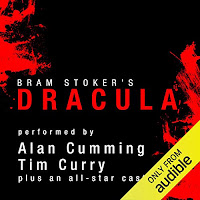
Dracula (Audible edition) by Bram Stoker

As part of my continued campaign to revisit classics, I chose to dip into this perennial Gothic favourite by giving the Audible edition of Bram Stoker's Dracula a spin. Then again, who can go wrong with this wonderful cast, including Alan Cummings, Tim Curry, and the late veteran audiobook reader Katy Kellgren, among others. 


I think it's safe to say that most of us have seen the movies and series inspired by Stoker's work, but so far few of them have been able to capture the depth and breadth of the source material. I first read Dracula in high school, and I admit freely that many of the subtler undercurrents went way over my head. Also, having just gone through Mary Shelley's Frankenstein, and with the work fresh in my mind, I can compare these two classics within the Gothic genre better. Each is quite a different beast, and while there is, in my opinion, more emotional and philosophical weight to Shelley's writing, there is, nonetheless, an astonishing attention to detail in Stoker's work.

Perhaps what makes this edition all the more special is the way that it cleaves to its epistolary nature by employing different readers to take on the letters and diary entries of the characters, imbuing each with their particular flavour and tone. In that way, Audible Studios has done well in their creative decisions. It's easy to close your eyes and sink into the narrative as the setting becomes fully tactile. 

Dracula is very much a product of its time, in which women are placed upon a delicate pedestal, and yet, if one is able to look deeper, it becomes apparent that Mina Harker is indeed one of the more heroic characters within this story. Her resilience and ingenuity is easily overlooked by Jonathan, Van Helsing and the others, and yet without her capable, stalwart assistance, I'm certain they would never have overcome the great evil that nearly overwhelmed them. The fact that they sought to shelter her from the dangers posed by the count nearly proved their undoing. 

This edition is slick, eminently listenable, and if you've yet to hit up the source material behind so much of our modern horror media, I highly recommend this audiobook.

Tuesday, February 16, 2021

Entreat Me by Grace Draven

I can never get quite enough of Grace Draven's writing when I'm in the mood for a gothic romance, which is very much her forte, offering crumbling edifices, doom-laden loves and clever dialogue. Her writing feels as though it harks back to the Brontë sisters, which makes me entirely happy (and yes, I'm a huge Wuthering Heights fangrrrl, so bite me). In Entreat Me, Draven riffs off the old classic Beauty and the Beast, but done in her signature style, which means you'll recognise elements of the template, but the story takes quite a number of surprising twists and turns.


In short, the widow Louvaen is fiercely protective over her younger half-sister Cinnia, and when the latter pulls a runner to abscond with a dashing son of a mysterious warlord in his remote demesne, Louvaen thinks nothing of it to play chaperone while the young lord courts her sister. Except Louvaen has run straight into the snarled thorns of a centuries-old curse, and her presence may well prove the linch pin to end it even as she finds her own love in the most unexpected place. 

Firstly, Louvaen is my kind of heroine. She's an older woman, she is brimful with courage and attitude, and she is not afraid to speak her mind ... or act. Which in a man's world can and does make her a powerful enemy (but I won't spoil). Draven has outshone herself with this book, delving deep in to the daily life surrounding a castle, and I absolutely adore the ring of authenticity she imbues in her writing, even to the details of spinning flax (yes, this is something I've actually recently researched). 

Entreat Me unravels slowly until it tangles into a cataclysmic end, filled with magic and danger and yes, true love. Her characters' interchanges are an absolute treat too, and she manages to bring across an archaic feel that is lively with humour. (Louvaen really has a sharp tongue that is a wonder to behold.) Yes, this is a kissing (and more) kinda book, but the erotic elements never overshadow the plot, which makes it my kind of romance.

Now excuse me, while I go track down the next book by Grace Draven that I haven't read yet...

Thursday, November 22, 2018

Eidolon (Wraith Kings #2) by Grace Draven

I'll start by saying that Grace Draven is one of the authors who's on my auto-buy list. Eidolon is the second book in her Wraith Kings series and continues the tale of the unlikely couple of Brishen and Ildiko. Now, more than ever, their mismatched marriage between Kai and humankind will be tested as a horde of demonic galla ravage the lands, Brishen is the only one who holds the power to stop them. After all, it was his scheming mother Secmis who inadvertently released the awful things.

As always, Draven conjures up a rich world with a detailed heritage. We get the impression of much history that has passed, that still affects the characters to this day. There is ancient magic and intrigue aplenty, and while romance is a strong element in all Draven's writing, it never feels out of place or overemphasised to the detriment of the plot.

Her realisation of a functioning magical system is plausible, which is a big deal for me in any fantasy novel, and she manages more than one narrative arc expertly. Granted, I'd have liked to have seen a bit more development in terms of try/fail cycles for individual characters, but that's a minor niggle from my side, because at its heart this is gothic fantasy that hits all the right buttons for me.

What I like best about Draven's writing is the effortlessness of her style, and especially the relationships between the characters – there's an authenticity to their interactions which I appreciate, in addition to the often lively dialogue. It's not so much the manic, plot-driving scenes but also the quieter bits in between where you glimpse characters imply *being* with each other.

Eidolon is an enthralling fantasy read, that ticks the boxes in terms of quests, mystery, magic, and enduring love.

Monday, November 10, 2014

The Dead Days Omnibus by Marcus Sedgwick #review

Title: The Dead Days Omnibus (The Book of Dead Days and The Dark Flight Down)
Author: Marcus Sedgwick
Publisher: Orion Children’s Books, 2006

Although this is marketed as two books, I’m going to treat it as one volume, since that’s how I read it – a nice-looking hardcover edition too.

Boy lives in the City, which exists as an amalgamation of a number of different European cities, presided over by a distant emperor. Boy has no idea who his parents are, and for the first few years of his young life, grows up on the streets. This is until the stage magician Valerian takes him in.

For a while, Boy is Valerian’s assistant for his show, which he gives as a highlight of a slightly down-at-heel theatre in the city. This is also where Boy encounters a girl – Willow – who assists one of the other performers. A hesitant friendship develops.

Of course if this were to be just a story about what happens at the theatre, there wouldn’t be much of a book. Soon enough, there’s a murder, and Boy, Willow and Valerian embark on a quest after a McGuffin – and the clock is ticking. They have until midnight on New Year’s Eve.

Marcus Sedgwick introduces us to a host of fascinating characters in a suitably gloomy and gothic setting. There really isn’t much substance to book one other than their quest, and an examination of the complicated relationship between Boy and Valerian. In my not so humble opinion, this relationship is straight-out exploitation.

As for the ending of book one, I gained the impression that Sedgwick wasn’t quite certain *how* he was going to finish, so the conclusion felt a bit convenient to me. Cataclysmic, yes, but I felt it was a bit abrupt. Ditto for the second book.

Boy and Willow are swept along by the adults’ machinations, and don’t seem to be all that active in affecting change around them – though they certainly aid or hinder the adult secondary characters.

That Boy is somehow special, there is little doubt, but it is only in book two, where I saw the final revelation coming from a mile away, that we realise exactly how special he is. More than that I won’t say (for the sake of spoilers).

In essence, we mix a dangerous McGuffin with a mad emperor, ambitious men, a whiff of brimstone and a suitably scary “Phantom”, and you end up with a bunch of disparate elements that are vaguely linked and don’t *quite* hang together.

So I’m basically sitting on the fence with this story. The Dead Days Omnibus is not a bad tale – not in the least. Though he has a tendency to randomly wander into omniscient third person (a personal bugaboo for me) he holds my interest, and I thoroughly enjoyed the mood and setting. I just felt that throughout this story that Boy was too accepting of his lot (I mean, he’s fifteen, and I remember all too well what I was like at that age) and that the plot of this story itself did not go beyond the obvious, linear. Elements like the Phantom could have been tied in stronger (this threat remains hanging around the edges but never quite resolved until the end).

Yet this *is* a lovely read, however, and especially thanks to the imagery, though I couldn’t truly engage with the characters in a meaningful way. But if a taste of the gothic is what you’re after, then you’ll gobble this up nonetheless.

Sunday, April 21, 2013

The Taker by Alma Katsu #review


Title: The Taker
Author: Alma Katsu
Publisher: Random House UK, 2011
Link:

If Interview with the Vampire and Wuthering Heights were your thing, then it’s safe to say The Taker will be right up your alley. Alma Katsu gradually unfolds her saga, revealing mystery upon mystery within a lush setting that spans centuries.

We are introduced to Lanore McIlvrae, a young woman who lives in a Puritan settlement and bears an impossible love for Jonathan St Andrew, the son of their small town’s wealthy founder. Contrary to my initial expectations, the love between the two was largely a one-sided affair – an all-consuming obsession, really.

I muttered quietly to myself: “This will not end well,” and continued reading. Lanore will stop at nothing to possess Jonathan. Her entire being is so focused on him that it precludes any rational decisions. But fate conspires to take Lanore away from rural Maine to Boston, where her path crosses with that of the decadent, cruel Adair and his entourage. Here she stumbles across a dark alchemical secret – one that offers her the hope that she might have her darling Jonathan with her forever.

Katsu offers a prose style that harks back to the classics, and the narrative of this novel shifts between the present, past and remote past. Readers are voyeuristically brought in near the conclusion of a tragedy. But the anticipation of revealing the mysteries that lead up to this point make this enthralling.

A warning: None of the characters are likeable. Lanore’s motivations are purely self-centred and short-sighted. Jonathan is a self-absorbed cad. Adair is a manipulative monster, and the assorted support cast are wicked and, in the case of the secondary narrator, Luke, weak-willed.

Yet, somehow, this brokenness of the ensemble works well together in their ill-at-ease relations. Much like Heathcliff or Lestat, Lanore is a creature who is simultaneously worthy of pity and admiration, and as much as one is apt to hate Jonathan or Adair, it is all too easy to fall under their spell. Lovers of the gothic novel need to perk up and indulge in this series – Katsu’s writing will hit all the right marks.

Wednesday, January 9, 2013

Not all Gloom and Doom… A Moment with Tunes of Dawn


My mate Carrie Clevenger has a habit of turning me onto new music. This is one of the many reasons why I absolutely adore her. One of the bands she introduced me to last year was a German outfit called Tunes of Dawn, and I am once again forever grateful for this new musical adventure. Then again, any band that covers the immortal Gloomy Sunday gets a serious kick-ass badge from me. So, naturally, I had to track frontman and bassist Hagen Schneevoigt down so we could shoot the breeze a bit. And at the end of this interview there will be a question you can answer by commenting on this blog (leave your name and email address so we can pick a winner). One lucky sod will win Tunes of Dawn goodies.

Now, over to Hagen…

I had to know what prompted the band to cover Gloomy Sunday. After all, there’s a bit of an urban legend attached to the song that suggests folks commit suicide after listening to it. The band plays on this theme in the music video.

Hagen responds: “Well, we always liked that song. And the legend is true. Gloomy Sunday was written by Hungarian musician Rezs Seress in 1933. It’s about how he lost his big love. It was said that many people attempted suicide after listening to it. We liked that story very much, even if it’s a sad one. But the song fit perfectly into the world of Tunes of Dawn, and so we did the cover.”

Watching that Gloomy Sunday video, and listening to the band’s music in general, it’s clear there’s quite a bit of a homage to Type O Negative, and perhaps even hints at Rammstein in more lyrical moments, even.

Hagen says: “Well, of course Typo O Negative is an influence. We always loved this band. But, in general, we have so many influences, like old Black Sabbath, Elvis and all the classic rock stuff. It goes from classic, jazz to pop and, of course metal. We all have different tastes, so in every song is a bit from everyone’s personal taste. But the main inspiration is life and all its up and downs. We prefer the sad and melancholic things. But always with a glint in the eyes.”

So, to poke at those wonderfully "sad and melancholic things" I had to ask Hagen one of my favourite questions: What songs from your past, do you look to for inspiration?

He responds: “It’s very hard to say ’cause there are so many beautiful songs we would like to do. Just to mention a few... two would be definitely Type O Negative: Love you to Death and Anesthesia.”

Then, the question I throw at all my vic— erm, interviewees… Now, you’re in a situation where you need to explain to someone who’s never heard of your music and who you are, and you have EXACTLY 16 words to do so...

Hagen says: “We are painting tragic but hopeful light with music, where others only paint shadows and darkness.”

Nice! Now, if Hagen had to pick one Tunes of Dawn song that really encapsulates what he thinks the band is all about… the lyrics, the choice of arrangements for the instruments. Why must listeners care about this song?

Hagen says, “If I must pick one, I would pick A Warm Sigh at 6°. The lyrics range between past, present and future. From sadness, hope and romance. From life, death and to dreams. Musically it is one of the more heavy songs, even it is not that fast. The melodic line and heavy guitars combined makes the song powerful, I think. We are better creating songs like that, than faster ones.”

Bands’ first-ever live shows often result in unintended hilarity. Whether this is due to Random Acts of Chaos or the wicked sense of humour belonging to the Heavy Music gods, we’ll never know. Hagen relates his own experiences with Tunes of Dawn: “Our first live show ever took place in June 1994. We were so excited, we did not dare to drink a single beer. Instead we drank lots of energy drinks by mistake. But at least everything went good. We still have some video footage of that show. Mostly we are laughing our asses off, because we look like teenagers playing death metal.”

Tunes of Dawn back in 1994
LOL, so they must have been like a bunch of Energizer bunnies on stage… But beyond musicians behaving themselves well, like musicians… The audience is also capable of behaving strangely. Hagen elaborates: “Well, strange things happen almost every time, more or less. But I remember one very funny thing back in 2008 when we had our record release show in Berlin. Some people made a huge banner out of underwear, about 10x4 metres. They took everything off that banner and threw it on stage. So the whole stage was covered with bras and panties and so on. It must have been about a 100 items.”

Undergarments aside, but staying with the clothing industry, as for what lies ahead, Hagen concludes: “At the moment we are doing a song for the Berlin-based designer Kilian Kerner for his new collection 2013. We will also perform the song at the Mercedes Benz Fashion Week this month. Furthermore we are currently writing new songs for our next album. The release is planned for fall this year.”

Now, be awesome little minions and go check out the Tunes of Dawn website here where you’ll find all their social networking links and more (go check out that music video already, will you?).

As for the question, name one Type O Negative song you’d love to see covered. (Answer by leaving a comment with your name and email address where we can contact you.) Entries will be open until January 17, 2013.

Friday, December 21, 2012

In conversation with Alma Katsu #guest


I recently had a chance to read The Taker by Alma Katsu and fell in love with the writing immediately and irrevocably. Katsu hit the mark with lush, evocative prose and dark tragedy. Supernatural elements that were present did not overshadow the narrative... So I'm naturally pleased as punch to have the lady in question visiting here today. Welcome, Alma!

The first thing that went through my mind when I read The Taker were a couple of novels I've enjoyed in the past. Anne Rice's Interview with the Vampire, Emily Bronte's Wuthering Heights... 

What evoked the spirit of The Taker for you? 

I’d say those two stories match up pretty well with what I had in mind. I wanted to write a big, sweeping, tragic Gothic love story. It’s the kind of story I love to read, but it seems (to me anyway) that there aren’t enough of them out there. If anyone’s seen the movie Orlando, directed by Sally Potter—it came out quite a few years ago now—it’s like that movie but with more naughty parts in it. The Taker a dark, star-crossed love story that spans time, where something fantastical and unexplained happens, and as amazing as the fantastical thing is, it still can’t saved this doomed love. And it has a great villain (if I say so myself) so is so drop-dead sexy but dangerous that he’ll make your toes curl.

This is a very telling quote: 
Nearly every person who came to know Jonathan tried to possess him. This was his curse, and the curse of every person who loved him. But it was like being in love with the sun: brilliant and intoxicating to be near, but impossible to keep to oneself. It was hopeless to love him and yet it was hopeless not to.

Lanny puts Jonathan up on a pedestal, and I'd be tempted to say he's not deserving of her affections. Tell us a little more about the dynamics between Lanore and Jonathan. It would almost seem as though he's incapable of truly giving of himself to anyone. Lanny's love is more a dark obsession which cripples her.

I got the idea for Jonathan for my experience as a music critic watching women throw themselves at rock stars, many of whom were married. The attention was relentless. The wives were at home with the children, knowing that their husbands were sleeping with groupies on the road. It was a trade-off for the wives: if they wanted to be married to these men, it was something they had to accept. Or get divorced, or abandoned.

That’s Lanny’s dilemma. Jonathan is a rock star of his time and place. He’s the handsomest and richest eligible bachelor in his small hometown. Most women of that time (early 1820s) would understand that marriage to Jonathan would mean accepting that he would have mistresses, but Lanny can’t accept this. Her problem is that she wants Jonathan, but she also wants their relationship to be perfect. She wants to be Jonathan’s complete world, for him to love no one but her, and that’s not going to happen. Before she accepts this, she’s going to try everything in her power to make him hers—and goes all the way into the supernatural.

Alma Katsu
Stories within stories... I gain the impression that The Taker went through quite a lot of development before you were satisfied with the final product. Did you learn any surprising truths about the characters while you worked? Any plot twists? 

The story changed a lot over in the ten years it took to write the first book. It changed in some ways to which I’ll never admit! The biggest change, though, happened with Adair. Because of his strong force of will, I saw that there was more to the story. Adair is the one capable of loving Lanny with this fierce passion that she wants—but he’s a monster. He’d have to change for her to be able to love him and for him to be worthy of her love. That’s what we see over The Reckoning and The Descent. Plus we learn what his story really is, where his power really comes from. Hint: he doesn’t even really know himself.

Immortality, as you envision it, is more a curse than a blessing. What are some of the greatest challenges faced by your creations?

Perhaps because I was raised a Catholic, I see immortality as a punishment, where you’re forever chained to your sins, reminded of them yet helpless to change the things you’ve already done. There are several references throughout the books to Marley’s ghost, from A Christmas Carol and that the characters in my books feel like ghosts drifting through the lives of normal people, unable to make them change their destructive ways. They’re unable to inspire others to change their ways because they haven’t been able to, yet. Only Jonathan, at the end of book one, has repented for his sins. He’s become a doctor and tends to the ill in remote places. Because he’s atoned, Lanny can’t refuse him when he comes to her to be released from this life. Of course she’d like him to stay with her forever, but because he’s not the shallow boy she knew and he’s made all these sacrifices, she can’t bring herself to deny him peace.

None of your characters are wholly likable (which in my mind makes me love this story even more). How do you balance out their negative qualities? 

First, I think all the characters are people we recognize from real life—even Adair. Jonathan is the boy who is phobic about commitment—maddening when he’s the one you want. Lanny is the girl who wants to be loved, perhaps a little too much. Adair is the bad boy who is caught unawares when he’s loved for the first time.

Too, it helps me to remember that there’s negative and positive in everyone. Nobody is perfect. We all go through phases when we might be more selfish or self-centered than usual. We all have done things that we wish we could take back. What I tried to do was catch the characters in moments of weakness and to dangle temptation in front of their noses, then sit back and see if they make the moral choice. As in real life, in most cases, they don’t and they rationalize why they don’t have to. But it comes back to haunt each of them until they learn their lesson or get their comeuppance.

And now, for the lighter side of the questions: 
Which three books do you constantly find yourself recommending others to read? 

David Mitchell’s Cloud Atlas used to be one but with the movie just out, I don’t think he really needs any more publicity so let me say: Into the Darkest Corner, a debut psychological thriller by Elizabeth Hayes. It’s very well-written but comes with a warning: it’s pretty disturbing. I’m also a fan of Audrey Niffenegger’s Her Fearful Symmetry. I know it wasn’t as beloved as The Time Traveler’s Wife but I thought it was a really interesting, an inventive take on ghost stories. The third would be my perennial favorite, Sandor Marai’s Casanova in Bolzano, probably the ultimate look at love.


Soundtrack or not? Do you find yourself drawn to music when you write? 

I listen to music to pump me up for a big, emotional scene or to drown out the background in noisy places. Other than that, I prefer total silence while writing. As for songs, let me say that I turned to Iris by GooGoo Dolls a million times to put me in Lanny’s frame of mind.

Destinations... Are there locations that crop up in your writing that you yourself would love to visit? 

That’s the case with almost all the locations in The Taker books, because I haven’t traveled nearly as much as I’d like. St. Petersburg is probably top of the list of places I’d like to do. I’ve been to Hungary but would love to go back. I’ve never been to Morocco even though it’s come up several times in The Taker books. Mongolia—which got cut from The Reckoning—is another place I’d love to travel to. Anywhere on the Silk Road, really.

Visit Alma Katsu's website  or sign up on her mailing list. Alternatively, follow her on Facebook  or Twitter.

Wednesday, October 3, 2012

Wuthering Heights by Emily Bronte #review

Ralph Fiennes will always be my Heathcliff

I first read Wuthering Heights by Emily Brontë at the tender age of fourteen, and remember quite clearly that it was my birthday, and my mom and dad took me out to the movies. One glance at the poster and I declared we’d go watch Wuthering Heights starring Ralph Fiennes and Juliette Binoche, and that was that. I was transported by the thwarted romance that played out on the bleak Yorkshire moors. Of course I had to go read the book straight after, and while my youthful self probably didn’t “get” half the relationship dynamics or the full depth of the dialogue, I nonetheless knew this is a book I’d need to reread at some point.

Fast forward 20 years (gee whizz, it’s been *that* long) and I downloaded the book from Gutenberg.org – a far cry from the battered paperback copy I inherited from the family home, and was immediately transported – again.

Wuthering Heights is primarily a story about relationships, and of people who willfully twist and allow others to twist them. We are first introduced to our narrator, a chap by the name of Lockwood, who has rented the grand Thrushcross Grange (complete with its own park lands). I get the idea the chap is a bit of a poseur, who’s quite oblivious and gauche when it comes to how he relates to people. Self-absorbed. I missed this in the first read. Kudos to Brontë for having a narrator I’d cheerfully slap. I mean, the fool goes blundering in to visit the inhabitants of Wuthering Heights when it’s perfectly clear to anyone else with half an ounce of common sense that they do not appreciate the intrusion of a stranger.

But Lockwood is our narrator, and it’s clear the mystery presented by the relationships he encounters captivates his imagination to the point where he’s determined to uncover they mystery that has presented itself. (My inner cynic cheerfully comments: “Well, what do you expect? They didn’t have reality TV in those days.)

Not one to take a hint when he’s not wanted, Lockwood plays voyeur, and an ill-timed visit results in him having to spend the night at Wuthering Heights and subject himself to the ghost of Catherine – one of the key scenes.

But the story’s layers get peeled back. Lockwood’s housekeeper at Thrushcross Grange is none other than Ellen (or Nelly, as she’s know by those who’re familiar with her), who grew up with the main participants in this drama. Her narration of past events is then retold by Lockwood, so once again our perceptions as readers are coloured by the lens of yet another viewpoint. We are faced with not only the opinions of Lockwood, but that of Ellen. Unreliable narrators both, but in their opinions, we view our main players with a degree of separation. We vicariously live out the unfolding tragedy from a safe distance while debating on characters’ true motivations.

Most often, Wuthering Heights is pegged as a romance and, to a degree I agree that romance is an underlying theme but I prefer to view it as a tragedy, of characters denying their true natures and being destroyed by the prolonged act of revenge.

We enter a complex interconnecting web of relationships and the intermingling of two families. Always, Heathcliff is the outsider. Brontë suggests that he is dark, perhaps of gypsy stock, and Catherine and Hindley Earnshaw’s father brought the foundling home. The lad was closer in age to Catherine than her brother, and the two were soon inseparable. But when Catherine’s path intersects with that of the wealthy Lintons of Thrushcross Grange, and specifically their son, Edgar, she is soon torn.

The unsophisticated Heathcliff is her dark half, an animus as such, wild and unfettered, yet Edgar represents culture and an artificial, societal construct of what “love” is supposed to be. Catherine is at a quandary, and it is her decision to marry Edgar that sets the wheels in motion for the unfolding drama.

Yes, this is a tale of thwarted love, but it’s also an illustration of how individuals will consciously choose a path that can only lead to damnation. What I found fascinating was comparing my initial response as a teenager to how I felt about the novel now, twenty years later. I recall feeling so sorry for how rotten Catherine’s life turned out. Now? Well, I’d dearly love to shake some sense into the girl. All the characters are unlikable  There is nothing romantic about Heathcliff’s all-consuming passion for Catherine. And Catherine is a willful  stubborn girl who’s used to bending everyone around her to her whims, unmindful of the damage she is causing to herself and those around her.

This made me think, however, about the relative ages of the characters in the story. They were but teenagers themselves, who behaved as such. The only difference is that in those days, folks getting married as young as eighteen was not unheard of. Now, you sit back and think about how your life would have turned out had you married your first sweetheart (you’re excused if it’s two decades later and you’re still happily married to your first love).

I think about my first love and where we’d be now if we were still together, and probably miserable as all hell to boot. Let’s not go there. I’m glad I never felt obligated to marry someone, and that when I did finally get married (yes I married young at twenty-two) I’m still very much in love with the man but glad I’d had experience with other relationships.

And lastly, Heathcliff. Wuthering Heights is really his story, if you ask me, and he suffers a bit of a dog-in-the-manger syndrome. He cannot have happiness, and has focused his entire existence on ensuring that no one else will have happiness. Heathcliff is ultimately tragic, but I don’t pity him, as he mastered his own fate and has essentially cursed himself. In the end, he cannot bring himself to carry out the final act of his schemes, and loses the taste for revenge. Instead, he turns the sickness inward. The world continues without him, in spite of his machinations, and he consumes his own heart.

Wuthering Heights falls under the category of the Gothic novel, along with the likes of Frankenstein. Supernatural elements are hinted at, and I suspect it’s left up to the reader to decide whether these exist. This is one of the novels that I recommend to all aspiring authors to read. As a study on character development, Wuthering Heights is essential. Yes, the language usage takes a little getting used to but if you can get into the story, you’ll gain an appreciation as to why this is one of those classics that has inspired film and music. (Go check out Kate Bush’s music videos on YouTube.)

Tuesday, August 14, 2012

Gothic Americana with The Victor Mourning #music


One thing I absolutely adore about social media is the way it’s brought me into contact with bands I’d never have encountered otherwise. The Victor Mourning are one such.

In the old days I might’ve borrowed a CD from a friend or, horror of horrors, have them record a tape. Nowadays all the really cool bands are lurking on websites like ReverbNation and Bandcamp, among others, and are easily accessible via Twitter and Facebook. And when I think back to the days when I used to root around books-per-kilo stores for foreign music magazines featuring music biz news at least a year out of date…

But getting back to The Victor Mourning, they’re really special, and an acoustic Gothic Folk or Dark Americana band that originally pulled together in Austin, Texas, in 2008. Stephen Lee Canner takes care of guitar and vocals, with Lynne Adele on guitjo and vocals, and Stefan Keydel on fiddle.

With regard to the group’s overall musical arrangement, Canner explains: “Our core instrumentation is guitar, guitjo (six-string banjo), and fiddle. Adele and I share two-part harmony vocals, which really is like another instrument in itself.

“Our last album featured a button accordion on one track, and I also play five-string banjo on the occasional tune.”

Although Canner and Adele have since moved to East Tennessee – which Canner names as the band’s spiritual home in the foothills of the Great Smoky Mountains – Keydel is still considered a part-time member.
Canner adds: “Keydel will still perform and record with us as distance and time permit. He recently flew in to record a few songs with us for an upcoming single and our next album. During that session we used a 19th-century reed organ to fill out the sound on one song. We’ll be looking for other folks to play with here in Tennessee as well. We’re very open to expanding the instrumentation as we meet other kindred musicians here: accordion, percussion, even cello.”

Canner himself lays claim to a musical legacy that infused his background that now finds expression through The Victor Mourning. He says: “I come from a long line of southern mountain people, and music has always been a big part of that culture. The music of the southern mountaineers often focuses on death, longing, sadness and tragedy, which were all part of everyday life in the days when that music developed. In my earlier days, I would write songs to fit whatever band I was in at the time (post-punk, 1960s garage, glam), but when I was home alone just working on my own ideas, I would write these plaintive mountain-flavoured tunes. In time I realised that these dark little acoustic songs just fell out of me naturally. They are in a literal sense a part of who I am. So it’s not so much about loving a particular style of music, it’s about having no choice in the matter.”

Canner says people from all walks of life responded to The Victor Mourning from their very first shows. “We get everyone from young hipsters to senior citizens coming up to us after a show, buying merchandise and being very enthusiastic about what we do. For some reason our song Zachariah is very popular with the pre-teens.

“In contrast, the person who books the acts for the waiting area at Austin-Bergstrom International Airport told us, ‘As you seem to focus on the darker side, I do not feel comfortable presenting you to our travellers.’ We took that as a huge compliment, of course. At a show in West Virginia an audience member told us that after seeing us he needed to see his therapist.

“Personally, though, I think our material is dark in that subtle, atmospheric way that much 19th-century Gothic literature is dark. It’s the darkness of an eerie old folk tale or a patch of woods with a legend attached. We don’t offer shock value, but we do offer mystery.”

Good news is that The Victor Mourning are laying down tracks for a new album. Canner says: “We’ve decided to take our time on this one in order to put out the very best product we can. I would expect that it will see the light of day by sometime next year.

“Before that happens, though, we have a vinyl 45 in the works. One side of the disc is Kill a Spider (Frankie Silver), an original of mine. The other is The Ballad of Frankie Silver, a traditional, 19th-century ballad. Both songs are based on the true story of Frankie Silver, who murdered her abusive husband in 1831 in western North Carolina, and was later hanged.”

Although the music business is in a state of flux, Canner remains optimistic. He concludes: “Writing and playing music are things we’ve always done and will always do. The times when the music at least pays for itself are nice, and the times when there’s a bit left over are even nicer. But regardless of economics, we’ll be playing music one way or another as long as we’re physically and mentally able.”

The Victor Mourning’s music is available at all iTunes stores, Amazon MP3 (both US and UK), eMusic, Napster, and also streams on |Spotify. CDs, T-shirts and The Victor Mourning Whiskey Soap can be ordered directly from the website: www.thevictormourning.com

This article initially appeared in the Sunday Independent Life supplement on Sunday, August 12, 2012.