Showing posts with label military. Show all posts

Monday, January 17, 2022

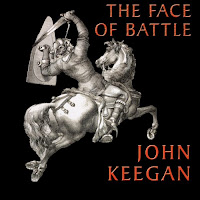
The Face of Battle by John Keegan

One thing I do a lot of these days is listen to audiobooks on subjects that will broaden my horizons as an author. And not only that, since I edit professionally where military situations often crop up, so it's important that I Know All The Things when it comes to the smaller details – like battle. The Face of Battle by John Keegan was included in my Audible subscription, and it was a no-brainer for me to pick it up. It helps, also, that the narrator, Simon Vance, has a wonderful voice. I'm now putting more works that he's read on my TBR list purely because I like him so much. 


Keegan's writing takes a little time to get into, but once I got past the introduction, I was accustomed to his diction and the subject matter. The Face of Battle looks primarily at how the experience of battle was for the average soldier – a reality often overlooked or glossed over in historical accounts that tend to glomp together combatants' experiences as if the armies were singular entities rather than units made up of individuals. 

How we, as human beings, face the trauma and tribulations of battle and extended warfare, is an undeniably complex subject. How we do battle, too, has changed profoundly over the years, as Keegan explains. While the topic of warfare over the centuries is certainly broad, Keegan picked three famous battles in which he showcased the changes: that being Agincourt (1415 CE); Waterloo (1815 CE); and the Somme (1916 CE). 

Once thing that is clear, is that our ways of killing our fellow humans have gone from the personal – featuring one-on-one conflict using blades – to the impersonal, involving ranged artillery bombardment that often lasts for months. How we write about these battles and history matters, for if we lose sight of how things are for the man on the ground, it's far too easy to embellish and gloss over the sheer weight of human misery. Issues such as supply lines, lack of communication, and dealing with injuries are just as important to consider as strategy and final outcomes. We see how commanders were once hands on, moving from site to site in order to maintain efforts, to the fact that those in charge often never set foot at the front – directing troop movements remotely. 

Keegan does well to illustrate the often fraught situations combatants find themselves in, giving a deep dive into the conditions in which many brave and often terrified men perished. I'd recommend this classic to anyone who is fascinated by military history or who wishes to gain a broad idea of how battles are enacted – and this is an important resource, I feel, for those who are looking at writing historical or military fiction.

Tuesday, January 12, 2016

Tower Lord (Raven's Shadow #2) by Anthony Ryan #review

Title: Tower Lord (Raven’s Shadow #2)
Author: Anthony Ryan
Publisher: Ace, 2014

While book one of Anthony Ryan’s Raven’s Shadow trilogy, Blood Song, is a coming-of-age story involving the young man Vaelin Al Sorna, and his rise as one of the greatest military leaders in the realm, Tower Lord diversifies the saga by adding fresh voices to the mix. To avoid spoilers, there’s an old (and favourite) individual from book one who makes a reappearance (no, he’s not dead, as you thought, and that’s all I’ll say), as well as the addition of two women who both show that they are not stereotypical damsels in distress.

Those hoping for the bulk of the story being told from Vaelin’s point of view will necessarily be disappointed, because his role is reduced to being assigned the duty of Tower Lord of the Northern Reaches, who then unites disparate groups in an army that then travels across the land to fight a great battle. I support Ryan’s decision to add new characters, because to a degree, the greater part of Vaelin’s achievements have already reached a peak in book one. To push for more would mean falling into the trap of “Too Much Awesome”, a flaw in many fantasy trilogies (You’ve rescued the princess – now what?). Though Vaelin is nonetheless a key figure in all that transpires in Tower Lord, the other three new viewpoint characters are given the opportunity to show that their roles are equally game changing when the realm is invaded, and its people are hard pressed to fight off enslavement.

Just like its predecessor, Tower Lord is red in tooth and claw, and is military fantasy to the highest order, with just a dab of magic for added spice (if you’re expecting dragons and elves, this is not for you). As always, Vaelin is drawn unerringly by his own magical “blood song”, as he calls it, which aids him in facing down impossible odds to pull off a rescue no ordinary person would even dare attempt. Reva and Princess Lyrna are well rounded out, and their story arcs are at times nail biting, because Ryan doesn’t spare them any grief.

There isn’t much to nitpick with Tower Lord apart from the fact that it clearly suffers book two syndrome in that it’s a continuation of events in book one with foreshadowing for events in book three – which means it feels unfinished, and the pacing might not have the same sense of urgency and energy present in book one. The writing, however, is tight and Ryan succeeds in offering his fans exactly what they’re looking for – a stonking good fantasy epic.

Thursday, March 5, 2015

Blood Song by Anthony Ryan

Title: Blood Song (Raven’s Shadow #1)
Author: Anthony Ryan
Publisher: Hachette Digital, 2013

It’s not all that often that I encounter a new fantasy author that I will gush about so much (likely to the annoyance of everyone around me) but my falling irrevocably in love with Anthony Ryan’s Blood Song happened within the very first chapter.

We are introduced to Vaelin, known as the Hope Killer, who from a very young age has been trained to be unquestioningly loyal to a religious militant order, prepared to kill and die for his faith, and at his king’s command (even if his king has questionable motives for his actions).

Blood Song is essentially a coming-of-age story, following Vaelin’s trials as he and his band of brothers gain their education and, above all else, survive the rigours of life in their order. It’s a harsh life, and the weak are quickly weeded out.

But not only must Vaelin succeed at his physical challenges – he must also navigate the Machiavellian political intrigue of the king and others, all while gradually uncovering a deeper mystery that may have the potential to overturn Vaelin’s entire world. Through all this, Vaelin constantly grapples with his honour, and notions of doing what is right when all choices laid before him force him into some sort of quandary.

Blood Song may be a bit slow-moving for those wishing to jump right into the action, but patient readers who enjoy a gradual unfolding will be rewarded by vivid, tactile world building populated with three-dimensional characters who will stick in your memory for a long time after you reach the end.

Ryan is relentless in what he has his characters endure, and the results are hardly convenient or tidy (as one can expect in an authentic setting). Expect bloodshed, violence and much death. Vaelin is a complex character whose actions aren’t always kind, but he is consistent in his logic, and I couldn’t help but admire him, even if I did not always agree with his decisions.

Ryan is also a bit of a phenomenon – Blood Song was initially self-published before it was picked up by a big publisher. The editing with this edition had a few idiosyncrasies, such as Ryan’s fondness for comma splices and a handful of instances of homophone abuse that clearly slipped past the proofreaders, but these minor transgressions did not rob me of my enjoyment of being at the not-so-tender mercies of a master storyteller.

I rate Anthony Ryan right up there with the likes of Robin Hobb, Scott Lynch, George RR Martin and Mark Lawrence, so if you’re in the mood for a touch of the dark side of fantasy, this may well be what you need to read next.

Tuesday, November 11, 2014

The City by Stella Gemmell #review

Title: The City
Author: Stella Gemmell
Publisher: Transworld Publishers, 2013

Some may have already encountered Stella Gemmell’s writing – she is known for having helped complete her husband, David Gemmell’s, Troy: Fall of Kings, after his death. The City is her first solo effort, and this tome is a big book in more ways than one.

The City, ruled by a supposedly immortal emperor, has been at war with neighbouring nations for so long no one truly remembers a time when there was peace. The City has stood for eons, with each age building on the ruins of the past. An air of decay and dissolution permeates everything, with the sense of a golden age that has passed.

The Reds try their utmost to defend the City from the invading Blues, and there are those on both sides who realise that this constant warfare must come to an end. But no only does no one really know who the emperor is, he is also ably defended by his guards and protected by the ruling families who lord it over the common folk.

The story unfolds over years, as we follow in the footsteps of a large, varied cast that includes sewer dwellers, disgraced soldiers and an exiled general – all who are fighting for survival and for a way to end the conflict.

Gemmell’s ability to hold together so many narrative threads is masterful. Not only that, but her attention to detail paints a vivid picture of the setting and its people, that unfolds gradually to create a magnificent tapestry of a saga. Even the tiniest detail is important, and Gemmell shows that she can hop from a tension-filled battle to a tender moment between lovers without faltering.

Mostly, The City is a story about those who are called to heroic acts, that on their own might seem like they don’t amount to much. When considered in their combined effect, these acts illustrate that these sacrifices do make a difference.

The only downside that I can think of is that readers don’t get enough time to deeply identify with any particular character, as there is so much going on. That being said, this novel is, as its title suggests, more about the war for a city’s heart rather than the individuals who bleed for it.

Lovers of epic military fantasy will be right at home with The City, which will toy with readers’ loyalties as characters’ allegiances shift, and battles are lost and won. The ending itself brings with it mingling disappointment. I asked myself, “Is this all?” but then I thought about the turn of events, and the fates of those who lived, and felt satisfied by the outcome.

Tuesday, October 14, 2014

War Stories: New Military Science Fiction with Andrew Liptak and Jaym Gates

I like Twitter. A lot. I've made some really schweet connections via social media, and running into editor Andrew Liptak via Twitter when he was finalising the War Stories: New Military Science Fiction anthology with co-editor Jaym Gates was one of those strokes of good fortune. Andrew and I chatted a bit, I turned the idea over of writing military SF with my own spin on it... And I figured out my story, "Only the Void and the Stars Between". I was, of course, totally stoked when they offered.

So, to share in the happiness and bubbles of the recent release of this fabulous collection of short fiction, I've invited Andrew and Jaym over for a little Q&A to look a little deeper into what went into this book.

Welcome, Andrew and Jaym!

What is it that you love the most about the military SF genre? Understandably it's quite a specialised niche in the genre, so what were some of the characteristics you were looking for in the stories that you selected for inclusion?

Andrew: I've been drawn to it for years because I've been fascinated by military history for a long time. I don't mean that in a way that I'm necessarily pro or anti war: it's a human behavior that's reprehensible, but sometimes necessary. Military SF is sort of the same thing: it's an interesting way to examine the morality of conflict.


What I personally enjoy is the idea of people making decisions while caught up in these major conflicts, and where we get to see how technology aids or hinders us, and how often, the role of the soldier's story changes very little from war to war (historically and in fiction.)

Jaym: I love the sort of pressure cooker of any fiction dealing with large-scale conflict. There are so many elements that most people either don't know, or don't stop to consider, and so we were aiming to bring some of those to light.

You've also aimed for diversity in the anthology. Can you give us a few examples of some of the contrasting stories and focuses? 

Andrew: Well, we wanted to explore some of the non-US voices here, because conflict appears throughout the world, and people approach it differently. One great example was Rich Larson's story, "Ghost Girl", which blends some elements from Africa with a style of warfare that really doesn't mesh with how we see it in the US. Here, I really got the sense that we have a historical background that the US doesn't share, which I found fascinating to read.

Jaym: One of the things I love most about this collection is that we have several stories that probably wouldn't count as military science fiction by normal standards. Thoraiya Dyer's story is about two female snipers – both with very distinct goals and drives – and the political and social currents surrounding them in a far-future Beirut. Mark Jacobsen's main character is a woman who used peaceful means to protest war, and, after her son is killed by the occupying forces, she uses that peaceful activism to draw attention to their plight in a very vivid, horrifying way. Ken Liu's main character struggles with the ethics of war – is it better to sacrifice one, or risk losing many?

At the same time, we have James Sutter and Maurice Broaddus with full-on combat stories, and Janine Spendlove's heartbreaking look at what rescue pilots have to deal with. Taken as a whole, I think we were able to bring together a very cohesive – if necessarily quick – look at the issues that are so very relevant today.

What are some of the challenges contemporary authors face in the SF genre – especially in the face of so many changes in technology? (There is always a fear, in my opinion, that writing can date easily.)

Andrew: Specifically with military SF, it's trying to imagine how war will happen with contemporary blinders. Starship Troopers is a Korean War novel. The Forever War is a Vietnam novel. Embedded is an Afghanistan war novel, and so on. The trick to imagining future war is to understand that it'll be completely different from any past experiences we've had with war – all the while, soldiers caught up in it hold the same role as they have for thousands of years.

Jaym: We've been working on this for just about 2 years now, and in that time, there have been tremendous leaps. Several of our stories have been requested by governmental, private, and corporate interests for use in dealing with current and extremely near-future military concerns. In ten years, we may be in a society where those stories are absolutely obsolete – something that SF frequently struggles with.

However, I don't believe that all work should always be completely technologically relevant for all of the future. Sometimes it's enough for a story to be highly relevant for a year, if it changes technology or society in an important way.

And, to be honest, it is bloody terrifying to think that we've published stories that are are being used in considerations potentially involving the life and death of other people. When you're writing, be very mindful that fiction can be absolutely transformative, for good or ill, so consider your words!

For those who're planning on writing SF for the first time, what sort of tropes do you feel they should be aware of (and avoid)? What are some of the tropes that you see the most often, and what would you like to see more of?

Andrew: Again, with military SF, I think that the big trope to be aware of is how war is seen from other sides – it's predominantly seen as a sort of conquest or colonization mechanism, and a certain enthusiasm or unawareness of this comes across as championing such actions. It's also good to realize that military SF (or military actions in general) aren't inherently a liberal or conservative issue.

Jaym: PTSD is a huge one. Veterans get treated badly by media as a general rule. PTSD is portrayed as an aggressive, violent, reactionary mental illness, when it is more likely to cause extreme depression and introversion. The stigma of PTSD damages the support and recovery of people who are already fighting an uphill battle.

The glory of combat is another. It's not glorious to go to war. It's awful. And even if you make it through unscathed, you've lived with a certain stress and uncertainty that changes your perspective a great deal.

Purchase War Stories on Amazon, Kobo or Nook

Monday, August 25, 2014

Legionnaire by James Gawley #review

Title: Exiles of Arcadia: Legionnaire
Author: James Gawley, 2013

One might be forgiven for initially suspecting this novel to be historical fiction set during the Roman era, but it’s definitely a work of fantasy. We find ourselves in the empire of Arcadia, where a renegade general has established his forces in a far-flung outpost.

Legionnaire is chiefly a coming-of-age story for the young Primus Seneca, whose father is a general of the exiled forces. Military life is all Primus knows – he grew up essentially abandoned by both parents – and we later discover General Marcus Seneca pushed his son away primarily because he reminded him too much of his estranged wife.

This abandonment does not prevent Primus from trying for personal excellence, though he is inexperienced and his idealism is great. He battles through difficult choices – guilt over a fellow soldier’s death, his friend’s desertion, and an obvious cover-up and framing – which have their repercussions later. Primus works out in his mind what it is to be honourable, and to do what is right, even when faced by overwhelming odds and the very real threat of death.

This is a short novel, which appears to be part of a series. If military fiction with great attention to detail is your thing, then this may well appeal to you. I liked the fact that this was a fantasy setting without overt magic. That being said, if the author had wanted to opt for straight historical fiction, he’d probably prove to be a dab hand at it as well. The setting has a nice ring of authenticity to it.

Some may find Gawley’s style a little spare – I didn’t feel any great emotional range in the writing, but I still enjoyed the unfolding story very much. The world-building is vivid, and tactile, which offered me a precise glimpse into the physicality of the milieu. This one may well be worth pursuing.