Showing posts with label GrimDark. Show all posts

Friday, November 10, 2023

God of Broken Things (Age of Tyranny #2) by Cameron Johnston

I am so late to the party on this one it's not even funny. This book has been sitting on my TBR pile for YEARS. God of Broken Things is the sequel to Cameron Johnston's Traitor God, in which we encounter the Tyrant magus Edrin Walker, who although much maligned by his fellow magic wielders, at the end of the day is the only one who possesses the power and the fortitude to scrape their collective posteriors out of the flaming frying pan. The reason why everyone hates a Tyrant is because their magical powers allow them to get inside others' heads, and no one is a fan of mind control, especially when the person with that power isn't a particularly nice individual. Which Edrin isn't. He's entirely self-serving and often snarky, with no regard whatsoever for social hierarchy, and this is magic combination that's never going to win him friends.


But for all his irreverence, he's not a bad sort, and all told is quite fun to hang around precisely because he doesn't give a toss about the things that matter in high society. His understated, often darkly absurd observations of the goings on around him are what made me keep on reading – if Edrin took himself too seriously, these novels wouldn't be half as entertaining. 

In God of Broken Things, we see our hero mucking about in the aftermath of the Big Bad that pretty much wrecked the city of Setharis in book one. Except he and the rest of the Arcanum (the mages who rule the city) face an even bigger bad that makes Edrin and his powers look like a minnow. And he's packed off back to the region where he grew up – to face not only the Even Bigger Bad, but also the things in his past he's been doing his darndest to avoid dealing with. I'm not going to spoil, but all I'll say is he has a really creepy gran. Oh, and did I mention that there was something that was even worse than the Even Bigger Bad? 

Of course he doesn't have to go it all alone – he has a few of his fellow magi from the Arcanum, including my favourite, Eva – a knight who in many ways is the perfect opposite of Edrin – and the interaction between the two is rather special. 

Now, Cameron doesn't do anything by half-measures. This is the second of his novels that I've read, and if epic, world-destroying cataclysms*, with a side order of demons, ravening hordes, and inter-dimensional beings blows your hair back, then you'll be in the right hands. The Age of Tyranny duology packs a whopper of a punch, with piles of action, cinematic battles, a rich, varied cast of characters, and some deeply fascinating world building while Cameron's at it. This is a fire cracker in the fine old tradition of GrimDark fantasy and well worth the read if you're looking for a story that will dance with all your favourite tropes but then pull a few sly ones when you're not looking. 

*If the old ultra-violence isn't quite your thing, then maybe skip this round, okay?


Wednesday, January 18, 2023

Art of War: Anthology for Charity, edited by Petros Triantafyllou

Every once in a while an anthology crops up that is an instabuy for me, and this is one of them, as I often feel that short fiction anthologies don't get enough love. And having edited a fair few myself, I know exactly how hard it is to get copies to fly off the shelf. Art of War: Anthology for Charity edited by Petros Triantafyllou offers fans of GrimDark fiction a veritable treasure trove of names, including such luminaries as John Gwynne, Mark Lawrence, Rob J. Hayes, RJ Barker, Ulff Lehmann, and a whole bunch of others in a selection of war-torn tales that vary between the darkly humorous to plain old dark, with plenty of ultraviolence and more. Nope, if you're squeamish, maybe this is not for you.


Like all anthologies, it's going to be a bit of a mixed bag, and I went into it knowing that not all the stories would be my jam. That being said, I am happy to report that on the whole, the stories hit the mark with me, and there were only a few that left me a bit meh. Even better, the anthology was put together for a good cause, with all proceeds going to MSF (Doctors Without Borders). So if ever there is even more motivation to egg you on to pick up a copy, there we have it.

War is ugly. War has also been overly romanticised in our media. When we read historical accounts of battles, we are often faced primarily with the dry opinions of historians who weren't there, or who focus on the doings of a few high-and-mighty general who didn't get blood on their hands ... or who took all the glory. Or even exaggerated the roles they played when it came to gaining victories. What I loved about the stories in this anthology, was that many of them focused on the human element, on those literally in the trenches. I did feel, however, that a more attentive proofreader might have caught the grammar goblins and gremlins, but the occasional dropped word or typo weren't deal-breakers for me, because on the whole, the quality of the writing more than made up for the occasional slip. But I feel I must mention the slips, for I saw a fair few of them.

I'm happy to recommend this collection of devious tales – and I'm not going to single out any of them because I prefer you to make up your own mind about what you like – to anyone who's looking for flights of dark fantasy that are, well, suitably grim, and occasionally with a slight glimmer of hope.

Saturday, September 10, 2022

The Republic of Thieves (Gentleman Bastard #3) by Scott Lynch

Admittedly, when I first read The Lies of Locke Lamora by Scott Lynch, I did so knowing that this was very much a Marmite book that elicited strong reactions in readers that sliced either way. It also took me a few chapters to get into Lynch's style, which veers away from the present convention for writing a tight first- or third-person to dwelling in a kind of limited-to-verging-on-omniscient style. But. Of course there's a but. Lynch does this so very well. And he won me over to the fate of Locke and Jean from the get go. 


You'll not find a slippier pair than these two friends who have a nasty habit of getting themselves caught up in cons that often go way over their heads. To the point where, with every instalment, I keep wondering how the heck Lynch's imagination gets so twisty. And not only that, but Lynch's style is right up there on the top shelf. The Republic of Thieves, which is book three in the Gentleman Bastard series, is an absolute cracker that I savoured over the space of a few months.

What I absolutely adored out of book three was that only only do we pick up on the basic cliff hanger left over from book two, which I won't spoil, but we see Locke and Jean given an 'out' from their predicament that may well cost them much more than they're prepared to pay. And Lynch's clever mind not only tells this story, of how Jean and Locke find themselves in the midst of helping throw a political election, pitted against someone who's rather a blast from the past (once again, no spoilers), but Lynch also nests an entire other novel within these pages, going back in time to how Locke, Jean, Sabetha, and all their fellow Bastards are sent off to strut the stage in a very Shakespearian manner in another city. What I enjoyed about this segueing into the past was that it offers a glimpse into Locke and Jean's formative years and their interactions with their old gang, which are an absolute joy to behold. 

Let me please just gush again about the exquisite poise, sly humour, and detailed world building in Lynch's prose. This is a book to be savoured. 

And I absolutely must quote my favourite line ever:
He had no chin to speak of, and long hair so ill-kept it looked as though a brown hawk had perched on the back of his head and clung there until it died.

This legit had me laughing so much I frightened the cat right off my lap.

Suffice to say, going into the depths of the story will spoil it for you, my gentle readers. If you've yet to encounter the misadventures of Locke and Jean, hie your bones to your nearest copy of The Lies of Locke Lamora, and take it from there. You're welcome. 

Monday, January 31, 2022

The Armored Saint (The Sacred Throne #1) by Myke Cole

Heloise is just an ordinary girl who helps her father, who does a lot of scribing work. They're well respected in their village, but all is not well in this world where an Inquisition-type organisation known as the Order hunts wizards. After all, it's thanks to wizards and their magical meddling that demons can find their way into Heloise's world to wreak havoc.


The Armored Saint
by Myke Cole is the first in a trilogy of stories, and I will say this much: I was drawn right into the world. Cole likes to take your preconceptions, turn them on their head, and then when he lulls you into a false sense of hope, he pulls the metaphorical rug from under your feet. Heloise as a protagonist is earnest yet awkward and her mistakes and missteps only add to the greater unfolding disaster.

She and her community face real horrors, where a religious authority holds great sway over their lives so that ordinary, good people are often coerced into doing bad things in the name of good – and Heloise questions the way things are done, and the outcomes of her doubt are not always to her advantage.

That which, at first, seems fair may be foul, and that which is foul may really be a last bastion of hope against the forces of evil – and ignorance of the way things actually as opposed to how one may wish them to be are may well prove deadly. There is a lesson here.

As far as fantasy novellas go, this one gripped me from the start, and the next book in the trilogy is an insta-buy for me. If you like your fantasy gritty and demon-haunted, then look no further than this offering.

Tuesday, June 29, 2021

The King Must Fall – in conversation with Adrian Collins

I'm a huge fan of Grimdark Magazine. They bring out a lot of awesome material, so it goes without saying that I sat up and noticed with editor Adrian Collins told me about his project, The King Must Fall, which has a stellar ensemble – go check out the Kickstarter page when you have a moment. I can't wait to read the anthology when it's out. In the meanwhile, Adrian has stopped by my blog for a quick Q&A...

Nerine Dorman (ND): Was there a particular creative brief that you put together for the authors for The King Must Fall


Adrian Collins (AC):
Definitely. For The King Must Fall I asked each author to write a story about a king or authority figure being deposed. I didn’t specify if they had to be simply removed, or killed, or if the attempt even needed to be successful – I can’t wait to see what they all come up with.

However, I think the most interesting part of this story is that the theme wasn’t my idea. I was trying to think of how to follow up Evil is a Matter of Perspective and just wasn’t having anything cool coming to mind. Out of the blue I received an email from Bradley P Beaulieu telling me about an idea he’d had for an anthology, but just didn’t have the time to drive – and because I love stuff like this, The King Must Fall was born!

ND: That's quite the stellar cast you've got going for your contributors. Which are the stories you’re most looking forward to? 

AC: That’s a hard one to pick. Just because I haven’t published them before, I’m really looking forward to seeing Daniel Polansky and Kameron Hurley’s short stories. 

ND: Did you think that certain themes will come through – I find this fascinating as an editor of anthologies myself, that there are often ideas that echo in the submissions – as if they have inadvertently drawn from the same well.

AC: I’m with you! One of the things I love most about building and reading anthologies is seeing how each creator puts their own angle or spin on the theme. Sometimes there will be similarities, and sometimes an idea completely out of left field will blow you away.  

For The King Must Fall I’ve received four first drafts, and a few of the other authors have sent through their ideas on what their stories will be, so I’m feeling really confident that they will all be thematically on point. And based on the authors we have, I know they are going to be dark AF and diverse in delivery. 

ND: What have you, as editor, enjoyed the most about putting together the anthology?

AC: I actually love the process of it. Pulling together all of the authors by leveraging years of author and artist relationships, speaking with printers and distributors and shipping companies, deciding how it’s going to look, planning out the financial requirements, timeframes, etc – all of the tiny pieces of a publishing project that eventually turn into a book. This is the stuff that I love doing. We already have stories coming in, and I’m loving reading them. I can’t wait to show the final product to our customers.

ND: Congratulations for funding this via Kickstarter – what, in your opinion, makes a Kickstarter campaign so successful? 

AC: In short, a clean, clear product that’s marketed really well makes a successful Kickstarter. Compelling content, an engaging video, rewards that can be grown upon through stretch goals, and consistent market engagement through advertising.

There’s also so many things that can go wrong during a process that’s often 6-9 months long. I’ve listed five key learnings from the three Kickstarters I’ve run over on Booknest.eu.

ND: Things in the industry have been, well, weird of late. What are some of your tips and tricks for keeping your publishing endeavours alive?

AC: GdM has experienced a pretty solid period of growth throughout the pandemic, to be honest. Key to where we are at the moment has really come down to a key structure change we implemented about 18 months ago: we split GdM into two arms – the publishing side, and the online content team – and got the right people in place to drive both.

The online content focus drives web traffic to our site and products. It’s created additional and improved revenue streams and grown our brand in the market, which has helped us thrive.

Other than that, the article I wrote for Fantasy Hive, called Starting and Running an Ezine in a few Simple, Soul-destroying Steps covers it in the further detail. 

ND: In the stories that you publish in GdM, what are the elements that you are looking for specifically? What makes you perk up when you read a submission?

AC: I’ve been looking for and finding the same thing for seven years: a grim story told in a dark world by a morally grey protagonist. Authors will blow me away with an anti-hero story that matters. A perspective that perhaps makes me recoil at first, and makes me want to engage more by the end. There doesn’t have to be a single drop of blood, but you need to show me grey morality.

And I can’t reiterate that enough: blood, guts, and sexual violence do not a grimdark story make (especially that last one, just leave it out please). It’s the anti-hero and the grey morality that win me over.

ND: Who are three up-and-coming voices in the grimdark genre you believe people should pay attention to?

AC: This is actually a hard question for me to answer. Before GdM I used to have time to read 50-60 books a year. Now I’m lucky if I get through ten. I’ve fallen behind the times on new authors I’m afraid! 

I will say that P Djèlí Clark, RF.Kuang, and Anna Smith Spark are three authors where I can’t wait to see what they release next.

ND: What do you love about grimdark fiction?

AC: I love that it feels more human. It feels like a story with somebody I know at the helm – like actual people and not indestructible superheroes are involved. I can relate to these characters because I can be and have been a screw up, and grimdark heroes are generally just bigger screw-ups trying to do better, but screwing up more.


More about Adrian...


Adrian Collins runs Grimdark Magazine and loves anything to do with telling darker stories. Doesn't matter the format, or when it was published or produced – just give him a grim story told in a dark world by a morally grey protagonist and this bloke's in his happy place. Add in a barrel aged stout to sip on after a cheeky body surf under the Australian sun, and that's his heaven.

Adrian and his team are currently working on The King Must Fall through Kickstarter.


Sunday, February 14, 2021

Fire Within by Morten W Simonsen

Fire Within by Morten W Simonsen is a fantasy novel that at the start, I felt, had a lot going for it. We kick off with a prison break then immerses readers in a world on the brink of war with a non-human race. The story centres around two brothers who, through circumstances, are placed at odds with each other by a father who requires nothing but exact compliance – and it's brother Ivan who's drawn the shortest straw, cast out of his family, outlawed and reviled, who now seeks to tear it all down from the bottom up with his outlaw gang. We have Thedric, who lives in the shadows of his elder brothers, who feels he can never quite measure up, to the detriment of his own selfhood as he tries and fails to impress his father, the Lord Styles.


Then we also have Ani, who is in possession of the kind of secret that will see her a valuable pawn in the hands of men who desire power. Out of all the characters, I feel she was the most poorly developed – either the author purposefully drew her out to be hopelessly naïve on purpose, or he doesn't know the first thing about writing a female character in the first place. I know I'm coming out a bit harsh here, but honestly, as a woman who's an avid fantasy reader, this has got to be one of the most frustratingly annoying characters I've encountered in years. Either way, she was the one reason why I wanted to hurl my iPhone across the room out of sheer annoyance. Then, the Thing (I think you can figure out what I mean without me saying it) that happens to her near the end was, in my opinion, so hopelessly unnecessary and as a plot device felt wedged in and something along the lines of 'let's do a terrible thing to a woman for the sake of being grim.' I get that her character is 'special' but the way she is developed as a character in this first book is the reason why I'm downgrading the review to three stars and will in all likelihood not bother reading the rest of the books. 

This is clearly the first book of a series, and as such there's a lot of set-up with a bunch of threads left up in the air at its close. Simonsen's writing is adequate, but I do feel this work could have used a bit of spit and polish not only from structural edits, but a bit more of a thorough copy edit overall. I saw quirks that only a copy editor would notice, which jerked me out of the reading (and I do try to separate my reader brain from my editor brain, but in this case I was not as successful, evidently). If you're looking for action-packed, grimdark, then this story will most likely hit the right buttons, but its execution was in my not-so-humble opinion a bit rough around the edges and in need of deeper development.

Wednesday, July 8, 2020

The Black Company (The Chronicles of the Black Company #1) by Glen Cook

I kept hearing about The Black Company by Glen Cook, so when the opportunity presented itself, I grabbed book 1. From what I understand, it's considered a classic, and in fact one of the earliest examples that sparked off the whole GrimDark genre.

Told from the perspective of a mercenary company medic, Croaker, we see the machinations between apparent forces of light and dark play out on the stage of a series of ever-escalating battles. This is military fantasy, plain and simple, so if descriptions of tactics, death and dying, bore you silly, this is not the novel you are looking for.

What I appreciated about The Black Company is that all the characters are morally ambiguous, and we have a big story told from the perspective of someone who's on the lower decks, who is not a big decision maker or player, but nonetheless ends up playing a pivotal part.

Croaker is self aware enough to know he's not in the service of the 'good guys'. In fact, as he picks apart the entire sorry mess of the Lady vs. the Rebel, he comes to realise that everyone has blood on their hands. He's all too aware of his frailty, and stands in awe of the magics at play as the Lady turns her closest servants into undead "Taken", much as Sauron has his Nazgûl. He's caught in the centre, the storyteller trying to make sense of it all, and watching how a prophecy slowly unfolds, and what its ultimate repercussions will be. In fact, there's an element of existentialism in this tale, as Croaker himself philosophises about the ultimate absurdity of it all.

Cook's writing makes you work, and reads like a relatively shallow musing that doesn't dig deeper into motivations, but hurries along and leaves you in the dust if you don't try make connections. So I can see why he's not for everyone. I enjoyed the camaraderie between the characters, the things not spoken of, and that there was a gradually unfolding saga against which Croaker's small part played out. I also liked the idea that things weren't explained to me, so that I had to draw my own conclusions from this morally grey story. Our main character is unashamed by the fact that he takes his pay, does his job, and reserves his opinion for his own private moments. As for whether this makes him good or bad, it depends on which side of his bow you stand.

Wednesday, April 22, 2020

The Ingenious by Darius Hinks

Okay, so wow, hats off to Darius Hinks for world building. In The Ingenious, he's created a city that immediately grabbed my attention in a way that I won't forget in a hurry. Run by a group of enigmatic alchemists known as the Curious Men, the city of Athanor is not bound by location. Fuelled by alchemy, the city travels from world to world, where it siphons off resources until its rulers deem it time for them to move again. Consequently, the city is a true melting pot of cultures, a sprawling grotesquery of races and architectural styles steeped in squalor for those who don't have power or wealth. I loved this dark, baroque setting hard, and Hinks does a good job of gradually revealing the city's nature.

Enter Isten and her people, a small group of exiles who want to go home. Except they have no say in where Athanor will next settle, and they're hard pressed on all sides by gangs. We stagger into the story just as Isten reappears from a year of drunken indulgence. She's a rogue and a drug addict who has lost her way, and scoffs at her group's idealism. She's also not above using them to get what she wants, and she can't think beyond the next hit.

I get it. She's not a nice person. And she ends up getting mixed up in events that are way beyond her ken when she tangles with one of the Curious Men. Alchemy is involved, as well as dubious moral codes, and just when you think things can't get worse, they do. Isten has no morals, no scruples, until suddenly she does, except after her dark teatime, she's so deep in the dreck that she has to do some fancy footwork to get both herself and the people she's close to out.

This novel has most of the hallmarks I adore in fantasy, but it falls just ever so slightly short of the mark, and I believe it's developmental in the sense that we don't dig deep enough into Isten, in terms of her motivations and her sudden about-face near the end when she has to turn from rogue to hero. We have hints of a wonderful interplay between her and her polar opposite, but I feel as if the story wasn't quite driven far enough for this to feel satisfying. After a promising start, the novel flounders and eventually rushes to tie up loose ends in what feels like a slightly haphazard fashion that left me needing a stronger resolution. Kinda like me sitting back at the end, saying, "Is this it?" There was a particular thread involving the Exiles and a secondary character that could have been foregrounded more to help create a greater sense of upping the stakes and lending more of a sense of urgency.

If you're in the mood for a slice of GrimDark with serious Gothic flavouring, then yeah, this will be your jam. There were some great ideas here, and a simply fabulous setting that's begging a deeper plunge, but I would have loved to have seen more in terms of better realised structure and deeper character development.

Saturday, April 11, 2020

The Last Wish (The Witcher #0.5) by Andrzej Sapkowski

I'm hopping on the fandom bandwagon a bit with this, but hey, YOLO. I've meant to read The Witcher books by Andrzej Sapkowski for a while now, and while my reading speed is seriously slow, I felt it would be an interesting exercise to tackle the books the series and the games are based on, and see where they differ. The Last Wish, which is where one needs to start, chronologically speaking, is more a selection of short stories from Geralt of Rivia's world, that are are more a nod towards our perennially popular fairy tales than a cohesive saga. Backstory, if you will. My favourite out of the whole bunch was the retelling of Beauty and the Beast, and I'm looking forward to seeing how Nivellen will be adapted for screen.

While the fandom is not quite as toxic as that of other IPs (like Star Wars, for instance), it will forever be divided between the gamer fanbois, book-thumpers and thirsty Henry-gasping females. Okay, that was possibly a bit disingenuous for me to describe it as such, but I've dabbled in the games and only really came on board after watching the series, and I can well imagine the scorn heaped upon me by the One True Fans who see me as a Jenny-comes-lately. Whatever. I don't care. And in any case, my opinion doesn't count for much in the bigger scheme of things. I believe there is room in a fandom for the source material and its adaptions to exist cheek by jowl, with the adaptions allowed to be exactly what the word 'adaption' means: a riff on the original, so expect there to be differences. And no, I don't give a flying fig whether you think game Triss or Yen are better than the series versions. 

I'm here to discuss the book, and it's clear that the show plays fast and loose with the source material, but in a way that I do feel stays true to the spirit of what I've read so far. It took me a few chapters to get used to Sapkowski's writing, as I'm sure much of the nuance was lost in a clunky translation from the original Polish. Little quirks with the dialogue tags bugged the hell out of me at first – smiling, nodding, grimacing etc of words – but I decided to shut my eyes and just go along with the ride. Highbrow literature this is not.

What is clear to me is the slyness of Sapkowski's humour. And Geralt is dry – very dry. In a way that makes me smile. This dude, he's seen pretty much everything, and yet here he is. Still putting up with people's nonsense. So in that sense, he makes a great narrator, and there's a fair deal of social commentary that flows in the undercurrent to make this more than just a bunch of action-riddled, monster-bashing quest.

What matters is that I'm invested. Thanks to the series and the games, I'm invested enough to go pick up the rest of the books. They have a charm all of their own. The Witcher is fun, surprisingly quirky, and should satisfy fans of the genre. Oh, and I'm here for the elves. Because I'm unashamedly shallow like that.

Sunday, March 8, 2020

Immortals' Requiem by Vincent Bobbe

I'll start by saying this much, Immortals' Requiem by Vincent Bobbe is not for the squeamish. Blending slashes of horror with dark fantasy, the story follows the points of view of multiple characters as they begin their descent into the catastrophic events that play out when an ancient evil awakens in Manchester. The apocalypse has arrived, and it's very hungry.

Cu Roi, otherwise known as The Miracle Child, is out of control, and after thousands of years asleep, intends to make his mark on a world ill equipped to deal with the being and his monstrous children, the barghests. In the time that he has been out of circulation, magic has faded even more, and those who would oppose him face a seemingly insurmountable challenge to fight a monster and its spawn.

If you, like me, don't have huge piles of time, this story is perfect – each section is short, and filled with non-stop action, so it's the kind of novel you can read bits of when you're on the go. At times I did feel that I had a little whiplash from all the shifting points of view, but overall Bobbe does a decent job of giving each character some screen time.

Briefly we dip into the world of the elves and their ilk, where a great cataclysm has all but destroyed the way of life of the two towers where the fair folk live. My favourite character out of the entire story was Cam, who's lived among humans for most of his life, having spurned his elven heritage, and who has fallen into a nihilistic pit of despair thanks to the fact that his people's magic is dying. The smart-mouthed elf is merely marking time, from bottle to bottle, and the fact that he doesn't want to be a hero, makes the fact that he's dragged, kicking and screaming into misadventure, all the more entertaining to watch.

Immortals' Requiem is a blood-drenched, ultra-violent quest that features a veritable bestiary of supernatural creatures. There's not much time for navel-gazing, and I'll hazard to say, don't pick too many favourites, as the body count is high. Be warned: this novel has its Army of Darkness moments. That should give you more than enough idea of what to expect.

Friday, December 20, 2019

Ranker's Charge: Deliverance at Van Demon's Deep by SP Steven

I don't think I'd ordinarily pick up a book like Ranker's Charge by SP Steven, but this was a review copy that landed on my desk so I gave it a fair read. This novella is very much in the GrimDark territory of fantasy, with morally ambiguous characters who are often faced with making awful choices. We meet Sergeant Vila Kiprik who's at the end of his career in the army and looking forward to retiring to his little cabin.

Except if the story were all about Kiprik's retirement, there wouldn't be much of a tale here. You see, Kiprik and his squad are responsible for clearing out the Unbound from an abandoned mine so that it can go in production again. It's bloody, dangerous work. Not only are the chaotically mutated Unbound a threat, but there are random patches of chaos that put in an appearance from time to time.

Fair warning, though, if you're not a huge fan of race-against-the-clock type disaster stories, then this one's probably not going to be for you. There's a load of tension in the telling, and if you think things can't go worse for the characters, think again.

SP Steven has a solid hand and a visceral, visual storytelling style, and while at the end of the day there's not much more beyond a main character fighting for his people to survive while coming to terms with his own demons, this is still an engaging tale. There are a few editing decisions that made me itch for my red pen, but no structural issues that made me twitch. Ranker's Charge is a prequel, and is meant as a teaser to draw you into this particular world, so if you're looking for a taste of something that might appeal without the huge investment of a trilogy, then give this a try.

Saturday, August 10, 2019

A Crown for Cold Silver by Alex Marshall

A Crown for Cold Silver by Alex Marshall has been one of those fantasy reads that sat on my TBR shelf for far too long. The moment that I got into the flow of the story, I could see that this was a novel that was constantly going to pull the metaphorical rug from beneath my feet every time I grew too comfortable. Kinda like GRRM but way, way smarter. And darkly funny, as in an “oh no, really, did HE JUST DO THAT?” kind of bleak, black humour.

Marshall takes all of the tropes we have grown to love about military fantasy, throws in a spot of interdimensional gates and devil-summoning, and delivers a novel that has no holy cows.

While the story maintains what I’d describe as a feeling of authenticity, it doesn’t take itself too seriously, and there’s a satirical buzz flowing along with the chapters that made me wriggle my toes in grim pleasure.

Told from multiple points of view, A Crown for Cold Silver is the first in a trilogy and brings readers into the epic years after the main players’ ‘happily ever after’ turned sour. We meet Zosia and her five Villains, veterans of a failed revolution when Zosia tried her best to tear down the Crimson Empire and bring about what I can only describe as a ‘people’s revolution’. Which didn’t work. And for 20 years, Zosia has been happily married in obscurity, having faked her own death. That is until the Crimson Empire massacres her entire village, putting the feared general on the warpath once again. And she’s a tough old bird. Even though she’s no longer young and quite as spritely.

Added to this are the machinations of the queen vs. the religious order of the Burnished Chain (so essentially secular vs. sacred rule), and a new bunch of renegades stirring up trouble in the spirit of Zosia of old. The entire novel follows assorted characters all headed towards the inevitable great battle, where old and new betrayals, reversals, and unexpected revelations are the order of the day.

What I appreciated about this novel was the way that Marshall portrays the futility of warfare for what it is, how people are wont to lie to themselves (and others) about honour, when at the end of the day everyone is reduced to so much dead flesh and gore. In the midst of it all, characters suffer existential epiphanies, while they struggle to make sense of their life goals once they realise that what they thought they wanted, isn’t necessarily for the best.

This is a deliciously ultra-violent, blood-drenched and awful story not for the faint of heart. I loved every minute of it. There were times when I thought of Pratchett’s Discworld, but just helluva darker and far denser in terms of writing.

Thursday, May 2, 2019

Road Brothers (Tales from the Broken Empire) by Mark Lawrence

Don't read this collection of short stories unless you've read Mark Lawrence's The Broken Empire. Here be spoilers. Road Brothers does exactly what it says – short stories sketching in back story for Jorg's band of brothers, offering tasty little snippets of history, to colour in the details.

So I'm assuming that if you've read Mark's other books, you'll be no stranger his style, which offers astute observations on the darker side of human nature set in a world that's still picking up the pieces of a cataclysm that destroyed civilisation as we know it, throwing it back into a dark age that marries up ancient, malfunctioning technology with dark magic. This uneasy blend is not quite fantasy, nor is it SF, and I love that ambiguousness of the setting.

Perhaps my favourite story out of the lot is the Nubian's origin, giving readers a tantalising glimpse into a post-apocalyptic Africa. Okay, so I'm biased because I love stories set in my stomping ground, and the Nubian was one of my favourites from the trilogy. (He stood out the most for me out of all Jorg's companions.) In my mind, some stories were more vignettes than a structured short story, but because I'm invested in setting, this didn't bother me so much and I appreciated the filling-in of gaps.

Essentially, this is an exploration of brotherhood, and the bonds between the brothers brought to life in the trilogy. It is about found family, notions of loyalty and honour, and also the complicated relationships between blood-relatives. Mark's writing isn't for everyone, but this selection will be valuable to those of us who're already immersed in his world.

Saturday, March 16, 2019

Mountain of Daggers (Tales of the Black Raven #1) by Seth Skorkowsky

I picked up Mountain of Daggers by Seth Skorkowsky because people were talking it up on the GrimDark Facebook group. It's a loose collection of tales following the doings of thief and miscreant Ahren, aka the Black Raven, as he goes about his business. Sometimes he's on top of things. Other times his opponents get the better of him. Seth's writing flows along at a decent clip, and he paints a well-realised world that promises to be filled with lore (kudos there). I wanted to nitpick a little but shoved my editor hat under the table, even though I'd have enjoyed having a go at him.

But where this book falls flat is the very concept that it presents – a series of vaguely interconnected stories about the legendary Black Raven. While there are key events that suggest motivation, the lack of overarching narrative to drive the story forward means that it loses some of its oomph. Look, it's not a bad concept, but it could have had a bit more meat to the bones, if that makes sense.

Don't get me wrong; I enjoyed the setting very much. There's most certainly action by the bucket load, but I wanted more depth to the character. As it goes, it feels more as if I'm an observer watching rather than actively participating.

This is still a worthy read though, and if characters with dubious moral inclinations are your thing, with a side order of swashbuckling and getting up to mischief, then you'll enjoy Mountain of Daggers immensely.

Sunday, June 10, 2018

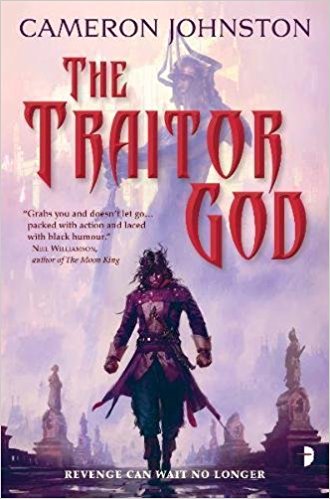
The Traitor God by Cameron Johnston

Every once in a while a review book that ticks all my boxes lands on my desk. The Traitor God by Cameron Johnston is just that. Smart-mouthed protagonist, check. An ancient, degenerate city filled with awful people, check. Mages and dark magic, check. Plenty of backstabbing, skullduggery and less-than-savoury, morally ambiguous characters, check.

Edrin Walker has been on the run for a decade, part of his mind locked away from him so that crucial parts of his memories of one fateful night in the city of Setharis are locked away. He’s done something terrible – he knows that – but as for what exactly, we’ll find out once he does. Not only is he a wanted man, but he’s also a practitioner of a rare kind of magic – of being able to manipulate people’s minds that labels him as a tyrant. Which is another black mark against his name.

When his bestie, Lynas, dies, Edrin (who happens to have a pack of bloodthirsty demons on his trail) is compelled to return to Setharis to solve Lynas’s murder and save the lives of the people he loves, whom he left behind all those years before.

Part murder mystery, part noir(ish) fantasy thriller, The Traitor God had everything I look for in a fantasy epic – in gory bucket loads. I can only describe my level of enjoyment as on par with all the reasons why I love games like Dragon Age so much. Johnston has nearly as much lore that he feeds into the story, trickle by trickle, so you feel as if you’re stepping into an ancient world oozing history. All the excitement. All the nail-biting boss battles and well thought-out magical systems.

His pacing is also on the mark; not once does he allow Edrin a moment’s respite, as he gets embedded into one untenable situation after the other – leaving me asking, “This can’t get worse, can it?” And then it does. Of course it does. And I found myself compelled to read (yet another) chapter. I especially loved the fact that he cleverly foreshadows many outcomes early on – so everything that happens early on in the story, has consequences later. He doesn’t shy away from violence either, and just a warning to squeamish readers – things do get rather messy near the end.

My question now is, when do we get the next instalment? I haven’t had this much fun with a fantasy novel in ages – this is most certainly one of my highlights for 2018. Johnston’s done a fantastic job, and if you enjoy the likes of Mark Lawrence, you’ll be right at home here.

Friday, December 29, 2017

Red Seas Under Red Skies by Scott Lynch

Anyone who finishes Red Seas Under Red Skies by Scott Lynch (book #2 of his Gentleman Bastard series) will understand why I muttered, “Damn it, Locke” under my breath when I reached the end of the book. As always, Lynch weaves a convoluted tale, filled with double crossings after double crossings, until unwary readers may go quite squint trying to keep up with things. And trust me when I say there were times during this novel that I wondered whether a) things could get any worse and b) how the heck the two friends were going to get out of their predicament. Which kept me turning pages, so I guess that’s half the author’s work done right there.

I will add that Lynch is one of the few fantasy authors who, in my mind, can get away with writing the kind of shallow third verging on omniscient point of view that he does. He sometimes skates dangerously close to withholding key information, but the break-neck speed of his telling at key moments means that even when he does neglect to share what Locke or Jean knows, he usually shows the rest of his hand soon enough after. So I forgive him. However I will state this much: I am difficult to please when it comes to omniscient third because so few authors get it right. Lynch gets around this by having short sub-sections per chapter, so that he cycles through characters’ points of view as and when it’s necessary, but every once in a while the author-narrator intrudes.

For fear of spoilers, I’m not going to go into a general overview of the novel, suffice to say that it starts out with Locke and Jean planning the heist to end all heists – a job that’s two years in the making as they execute their designs of the aptly named Sinspire gaming house.

The environment in which they find themselves is decadent to say the least, and I lapped up the descriptions of the people. Lynch’s world building is intricate and layered, and I’ll hazard to say that nearly every small detail is important – so take note. He does a lot of foreshadowing to get around the fact that he doesn’t immediately clue you in with the full details. You’ll know something is afoot, but not much more than that until he reveals.

Also, I went into this novel expecting one thing, and about halfway through Lynch pulled the rug from under my feet and the kind of story I thought I would be reading turned out to be something completely different. I won’t say what, but it was awesome, and fun, and he introduced me to some unforgettable characters.

Damn it, Lynch. There is The Thing that happens near the end. I won’t say what but I was gutted. Not quite to the degree that I am reading Robin Hobb, but pretty darned close. And that’s all I will say on the matter.

Getting into Red Seas Under Red Skies was not immediate, as it felt to me that there was quite a bit of setting up that happened before the story really got underway. Lynch’s style isn’t for everyone, nor is the subject matter – focus is very much on action rather than emotional layering, which he keeps close to his chest. But once I got going, I was invested, and that’s what counts. I really do love the dynamics between Locke and Jean, even if the novel tends to stagger around unexpectedly. The worst part is that I finished reading the novel while on holiday in an area where I had to walk 1km to just get cellphone signal, so at the time I couldn’t go google to see whether there’s another novel to follow up this one… Yeah, it was that sort of book. (And there are more in the series… so I’m happy)

Friday, September 15, 2017

Prince of Fools by Mark Lawrence

I'm a horrible, horrible person because I've taken *months* to finish Prince of Fools (The Red Queen's War #1) by Mark Lawrence (Goodreads tells me I started during December last year and it's quite inexcusable, really, that I've tarried so long). But that's what Mark's writing is to me – something to savour. The Red Queen's War is the next trilogy to get into if you've discovered and loved The Broken Empire trilogy.

But let's talk about Jorg Ancrath first, our bad-boy, maverick prince from The Broken Empire. Here we were faced with a delightfully psychopathic adventurer who had absolutely no regard for his own personal safety or long-term survival. Jorg would heedlessly fling himself from one untenable situation to the next, offering astute commentary along the way that signals a lively mind and a somewhat absurd sense of humour.

The howling of readers by the time book three drew to a close, that Mark was *finished* with Jorg... Well, it was adorable. [She says with a smile, gives Mark a high five for stopping when the going is good.]

Sensibly, Mark went on to create an entirely different tone in The Red Queen's War with our new friend Jalan Kendeth, 10th in line to the Red Queen's throne and unashamedly a lying, gambling womaniser, whose healthy sense of cowardice has kept him alive all this time. While Jalan is no Jorg, he's certainly still a smart-mouthed chap, so his explanation of events as they unfurl is half the fun.

Jalan is a reluctant hero. Haring off to the frozen north to face a great evil is the last thing on his mind, but there are larger forces at play in this cracked world where magic is bleeding back in to cause untold chaos. Jalan, and his equally reluctant counterpart Snorri ver Snagason, find themselves bound together as pawns in a game where they don't have all the rules. True to Mark's writing, there is plenty of bloodshed, death, violence, wenching and all the things that soft-hearted, gentle readers may want to avoid.

Evidently I'm not a soft-hearted, gentle reader, so I quite happily followed our two lads from one misadventure to the next. Knowing what I do about Mark's writing, and how he puts his stories together, I'm suitably entertained and looking forward to the other two instalments in the trilogy.

I must add here that I particularly adore Snorri. Part of me feels as if *he* is the actual hero of the story; Jalan is merely the storyteller spinning a saga about a mythic warrior and father on a quest to save his family. On the outside, Snorri appears to be *just* a hulking brute, but slowly the layers are peeled back and you discover a character of great complexity and subtle intelligence. I like it when that happens.

In essence, Prince of Fools is a dudebro quest, so it's probably not going to appeal to those wanting a story that passes the Bechdel test. That being said, there were some cameo appearances that amused me greatly (you'll understand why when you read the book – it does take place during the same time that Jorg has his adventures). And seriously, this was just a huge load of fun to read, gore and all, especially with Jalan's witty observations along the way and some of the unexpected twists that had me shaking my head.

Thursday, March 5, 2015

Blood Song by Anthony Ryan

Title: Blood Song (Raven’s Shadow #1)
Author: Anthony Ryan
Publisher: Hachette Digital, 2013

It’s not all that often that I encounter a new fantasy author that I will gush about so much (likely to the annoyance of everyone around me) but my falling irrevocably in love with Anthony Ryan’s Blood Song happened within the very first chapter.

We are introduced to Vaelin, known as the Hope Killer, who from a very young age has been trained to be unquestioningly loyal to a religious militant order, prepared to kill and die for his faith, and at his king’s command (even if his king has questionable motives for his actions).

Blood Song is essentially a coming-of-age story, following Vaelin’s trials as he and his band of brothers gain their education and, above all else, survive the rigours of life in their order. It’s a harsh life, and the weak are quickly weeded out.

But not only must Vaelin succeed at his physical challenges – he must also navigate the Machiavellian political intrigue of the king and others, all while gradually uncovering a deeper mystery that may have the potential to overturn Vaelin’s entire world. Through all this, Vaelin constantly grapples with his honour, and notions of doing what is right when all choices laid before him force him into some sort of quandary.

Blood Song may be a bit slow-moving for those wishing to jump right into the action, but patient readers who enjoy a gradual unfolding will be rewarded by vivid, tactile world building populated with three-dimensional characters who will stick in your memory for a long time after you reach the end.

Ryan is relentless in what he has his characters endure, and the results are hardly convenient or tidy (as one can expect in an authentic setting). Expect bloodshed, violence and much death. Vaelin is a complex character whose actions aren’t always kind, but he is consistent in his logic, and I couldn’t help but admire him, even if I did not always agree with his decisions.

Ryan is also a bit of a phenomenon – Blood Song was initially self-published before it was picked up by a big publisher. The editing with this edition had a few idiosyncrasies, such as Ryan’s fondness for comma splices and a handful of instances of homophone abuse that clearly slipped past the proofreaders, but these minor transgressions did not rob me of my enjoyment of being at the not-so-tender mercies of a master storyteller.

I rate Anthony Ryan right up there with the likes of Robin Hobb, Scott Lynch, George RR Martin and Mark Lawrence, so if you’re in the mood for a touch of the dark side of fantasy, this may well be what you need to read next.

Friday, November 29, 2013

The Company of Birds, excerpt #FridayFlash #fantasy

I recently started work on my next "serious" novel (well, one that I pin big hopes on). So here, for your reading pleasure, and because I haven't done it in ages, is a spot of Friday Flash. The novel is entitled The Company of Birds and no, I have absolutely no fucking clue when it will be done. It's going to be a bit on the GrimDark side, since I'm totally blaming GRRM and Mark Lawrence for showing me the way. 

YES. I drew the bird.

* * * *


A dull thud shuddered through through my study and the pigeons that had been sunning themselves on the window ledge took to wing in an explosion of feathers. I paused, pen in hand. What in all the gods’ names could cause such a disturbance? There’d been the time when one of the first-years in the Department of Alchemical Engineering had mixed dragon’s breath with salt-of-Byr, “just to see what would happen,” as he’d put it, but the resultant detonation had been mild compared to this.

I’d felt this deep in my collarbone. Not quite alarmed just yet, I rose and approached my window. Not that I’d be able to see much, because I looked directly into the roofs of the Greater Library. Theoretically, my window faced in a northwesterly direction, toward the harbour. All I saw were terracotta tiles with most of the green glazing worn off by the decades.

A thick pillar of black smoke rose into the clear, late-summer sky.

I stared stupidly for a moment until it registered that whatever burned must be large, possibly one of the warehouses by the docks. The positioning was about right. This time of year there’d still be large quantities of marine oil in stock, not to mention the first harvests.

Damn.

A tap sounded at my door.

“Come in,” I called.

Big blond Isha shouldered in. “You might want to come take a look at this.”

“What”?

“C’mon.” She gestured once then ducked out again.

Whatever it was must relate to the explosion and I was torn between returning to the translation with which I’d been busy and following my colleague. After all, it wasn’t as if Uitenbach was immune to its troubles. Nowadays there always was some sort of trouble.

I sighed and hurried after Isha. I’d been sitting at my desk for the past three hours. I needed a break and my stomach growled in a way that told me I’d probably skipped lunch.

Isha waited for me on the corner, and I fell in at her side.

“You walk too fast,” I muttered.

“You spend too much time at your desk.” She flashed me one of her irresistible grins.

I liked Isha. The Ouertian woman was everything I was not—tall, commanding and well-muscled. Then again, a woman needed confidence and brawn by the cartload if she wished to claim the title of maga in the Faculty of Alchemical Engineering.

We made an odd couple, but then again magas were in short supply here at the academy. We stuck together when and where we could. And the gods knew, these days I needed all the support I could.

The Greater Library had a terrace with an actual sea view, and that’s where we headed, and we were not the only ones with the same idea. An assortment of faculty members and students trailed along, fish caught in a current.

“It’s a container of grain that spontaneously combusted,” someone muttered. “Safety regulations have been slipping.”

“Arson,” Head Librarian Matthias, said under his breath as we passed his desk.

He shot us all filthy looks as we traipsed into the hallowed grounds of his domain, as we were no more than lowly first years without the correct documentation.

I blinked in the sunlight and the dry heat of late afternoon. I’d definitely missed lunch. About a dozen or so staff leant over the railings and shaded their eyes against the glare, and Isha and I elbowed our way into a space of our own. The bay was redolent in its usual azure dropping off into cobalt farther out in the ocean, but where the big warehouses of the Fadari family stood was an inferno. We could see the bright orange tongues in great detail and thick black smoke roiled into the sky like some living thing..

Isha gave a low whistle. “Those flames must be at least eighty feet.”

“Not much work going to get done today,” I said, and pointed to the people crowding the rooftops below us.

My companion gave a low grunt.

Alarm bells added their bronzed voices to the muted roar of the blaze, and we watched as some of the engineering magisters rallied their students in the Ruby Square below. This was bad enough that the academy was sending in support. They wouldn’t expect academic staff to pitch in, but the first-years would definitely be expected to “volunteer”.

“Glad that’s not us,” I said to Isha.

“We should go help,” she mused.

“You maybe. What can I do?”

She laughed. “You’d get caught in an updraft and turned into a cinder.”

Our colleagues muttered among themselves. By all rights we should be more alarmed, but after the riots these three winters past, I was certain none of us could dig deep enough to worry more than we already did. This was yet another symptom that all was not well in Uitenland.

Monday, November 11, 2013

King of Thorns by Mark Lawrence #review

Title: King of Thorns (The Broken Empire #2)
Author: Mark Lawrence
Publisher: Ace Books, 2012

There's a lot going on with King of Thorns that begs me to go back and read it again soon. Firstly, hats off to Mark Lawrence for juggling a non-linear story structure. We follow Jorg on his wedding day when he goes toe to toe with the golden boy, the prince of Arrow, who's set to become the emperor. Or at least that's what everyone keeps saying. We simultaneously also follow the events that happened to Jorg four years ago, as he settles in his position of king of Renar.

The Jorg we follow in book #2 is still impulsive, but his nasty side has been tempered somewhat. He's haunted by ghosts, and is vastly troubled by his connection to Katherine. But this is no Romeo and Juliet situation. Not by a long shot.

Though we can level accusations at Jorg that he's a killer and capable of all manner of truly terrible things, it's also evident that he's matured. He has begun to realise his own strengths and weaknesses, and perhaps what makes him more dangerous is that he has a better understanding of when to give in to his impulses and when to plan ahead.

Jorg wrestles with the growing realisation that he's merely a pawn on a gaming board, and he absolutely refuses to bow down to others expectations of him. His anger at being played fuels his desire to rip free of this figurative briar patch in which he finds himself.

Lawrence builds tension *very* well. In fact, so well that at times when I was tempted to say, "Oi!, dude! You're withholding key information here!" the next chapter comes along and furnishes us with sufficient backstory. This back-and-forth jumping between past and present will probably annoy some readers, but I'm not one of those. All I can do is stand back in slack-jawed wonder at how Lawrence managed to hold onto all those threads.

It's not so much the world-building that's fantastic. I mean, it's pretty standard – post-tech, post-apocalyptic Medieval setting where reality is a little more malleable than your average SF nut would want to allow. Jorg finds himself in a battleground, yet Jorg himself exists as a nexus point and a battle ground in his own right – between the forces of Death and Fire.

All I can say about my expectations of book #3 is that this story cannot end well, but I'm sure as hell going to enjoy the ride. Jorg is a dark star that burns brightly, a comet that will destroy the world even as he remakes it according to his own vision.

I don't know when last a fantasy series has excited my imagination quite so much. What makes it for me as well is Jorg's observations on the nature of people and the world around him. I don't normally highlight while I read on my kindle but this novel calls for me to make exceptions. Jorg has a particular presence, for lack of better description. He is broken, but instead of moping, he is fuelled by his bad experiences and won't lie down and die, no matter how bad things get. And for that, I admire him.