While a bunch of the previous field guides I've reviewed have been somewhat on the small side, this one's got it just right. Surely, unless you're hiking in the bundus specifically to go moth-hunting, you're going to go to the trouble of carting this along and deal with the weight. It's a big book. But for your reference library, it's perfect.
Monday, September 29, 2025
Southern African Months & their Caterpillars
While a bunch of the previous field guides I've reviewed have been somewhat on the small side, this one's got it just right. Surely, unless you're hiking in the bundus specifically to go moth-hunting, you're going to go to the trouble of carting this along and deal with the weight. It's a big book. But for your reference library, it's perfect.
Tuesday, February 4, 2025
Guest Post: 6 Purr-fect Cat Movies Based on Books by Vanessa Morgan
Do you think cats rule the internet? Wait until you see how they dominate the silver screen—especially when their movies are inspired by books.
To celebrate the release of my book Meow! Cats in Horror, Sci-Fi, and Fantasy Movies, I'm diving into six unforgettable feline flicks that started as books.Meow! dives much further into these six films and many others, with many behind-the-scenes insights, fun facts, and plenty of feline flair. It's the ultimate guide to all things cat cinema.
6 Purr-fect Cat Movies Based on Books
By Vanessa Morgan
1) Kiki's Delivery Service (1989)
Based on the novel by Eiko Kadono, Kiki's Delivery Service is a charming coming-of-age tale about a young witch navigating independence. Kiki’s black cat, Jiji, is her constant companion, offering sarcastic quips, loyal support, and comic relief throughout her delivery adventures. Jiji isn’t just a sidekick; he represents Kiki’s inner voice, grappling with doubts and confidence as she grows. Studio Ghibli’s adaptation perfectly captures the heart of this story, with Jiji stealing the spotlight as one of cinema’s most lovable feline characters.2) Apocalypse Z: The Beginning of the End (2024)
This recent horror film, adapted from the novel by Manel Loureiro, takes the zombie apocalypse genre to a chilling new level—and a cat plays a surprisingly pivotal role. In a world overrun by the undead, the protagonist’s tabby is a loyal companion that offers comfort and a sense of normalcy in a world descending into chaos. The cat’s presence in Apocalypse Z highlights the human need for connection and hope, even in the darkest times.3) The Three Lives of Thomasina (1963)
Based on Paul Gallico’s heartwarming novel, this Disney classic tells the story of a little girl, her veterinarian father, and their beloved cat, Thomasina. Narrated by the cat herself, the film explores her three “lives” as she connects the fractured family and helps them rediscover love and compassion. Thomasina’s role is both magical and deeply emotional, embodying themes of forgiveness and healing.
4) Morgiana (1972)
Adapted from Alexander Grin’s gothic novel Jessie and Morgiana, this Czech psychological thriller is a tale of envy and deception, where a mysterious feline plays a hauntingly symbolic role. The feline is a representation of guilt and justice (much like in Edgar Allan Poe's short story “The Black Cat”), mirroring the sinister undertones of a sibling rivalry that spirals into murder.
5) Felidae (1994)
Based on Akif Pirinçci’s novel, this German animated neo-noir film is anything but your typical cartoon. Francis, the feline protagonist, is a detective who uncovers a sinister conspiracy while investigating gruesome cat murders. Intelligent, gritty, and surprisingly philosophical, Felidae explores themes of morality, power, and survival, all through the eyes of its feline characters.
6) The Cat (1992)
This Hong Kong cult classic, adapted from Ni Kuang’s book series, blends sci-fi, horror, and martial arts into a bizarre yet entertaining cinematic experience. The story centers on an alien cat and its human allies as they fight a malevolent extraterrestrial force. The Cat is without a doubt the craziest cat movie ever made.
Final Thoughts
Cats have captured our hearts in books, movies, and just about everything else! Luckily, these six cat movies based on books are just the beginning of what’s out there. Whether you’re a fan of spooky stories, sci-fi escapades, or charming magical journeys, there’s no shortage of feline-inspired entertainment. Plus, you’ll find all of these films—and over 200 other cat-centric tales—in Meow! Cats in Horror, Sci-Fi, and Fantasy Movies, your ultimate guide to the world of feline cinema.
Now it’s your turn—what’s your favorite cat movie or book? Is there a feline hero or literary kitty with a special place in your heart? Share your pick in the comments!
About Vanessa Morgan
VANESSA MORGAN is the editor of When Animals Attack: The 70 Best Horror Movies with Killer Animals, Strange Blood: 71 Essays on Offbeat and Underrated Vampires Movies, Evil Seeds: The Ultimate Movie Guide to Villainous Children, and Meow! Cats in Horror, Sci-Fi, and Fantasy Movies. She also published one cat memoir (Avalon) and four supernatural thrillers (Drowned Sorrow, The Strangers Outside, A Good Man, and Clowders). Three of her stories became movies. She also introduces movie screenings at several European cinemas and film festivals and is a programmer for the Offscreen Film Festival in Brussels. When she is not writing, you will probably find her eating out or taking photos of felines for her website, Traveling Cats.
Tuesday, January 17, 2023
Beneath the Sands of Egypt by Donald P Ryan
In listening to this audiobook, beautifully narrated by Paul Boehmer, I also inadvertently also learnt a lot more about the importance of fibre technology in ancient Egypt than I expected I would (!!!) – and I love it when books deliver such seemingly inconsequential factoids. Yes, there is an Egypt Papyrus Museum, and yes, I want to go there one day.
Wednesday, January 11, 2023
Tutankhamen by Christine El Mahdy
I'm also an adept at Google-fu, so I was rather saddened to learn that El Mahdy passed away a good few years ago, and doesn't have much of a footprint. Which is a pity, because she makes some compelling arguments in her book that differ from the generally accepted conventions related to the Amarna Period and its direct aftermath.
Thursday, December 1, 2022
Red Land, Black Land – Daily Life in Ancient Egypt by Barbara Mertz
As the book's title suggests, this is an overview of daily life in Egypt, from the royal pinnacle of ancient Egyptian civilisation, the pharaoh and his pyramids, all the way down to the Black Land's peasants. In it, we gain an almost tactile idea of what life during the ancient times must have been like – what people wore, how they built their homes, what pets they kept, what they ate. For a subject that can, excuse my choice of words, be as dry as dust, Barbara injects wit and verve into the text in a way that makes for an engaging journey of discovery.
Wednesday, November 23, 2022
Field Guide to the Amaryllis Family of Southern Africa & Surrounding Territories
The Amaryllis family of southern Africa has many, many more species in it than I expected. Actually, I wasn't sure what to expect when the Field Guide for the Amaryllis Family of Southern Africa & Surrounding Territories by Graham Duncan, Barbara Jeppe, and Leigh Voigt landed on my review pile.
Monday, May 23, 2022
Bury My Heart at Wounded Knee by Dee Brown
There are no two ways about it: the effects of colonialism are devastating for those who find themselves on the wrong side of the settlers' guns. I'd heard much of Dee Brown's Bury My Heart at Wounded Knee, so when the title turned up in my Audible subscription, I gave it a listen. And I'm so glad I did. The book really put a lot into perspective in terms of an American history that I had, up until now, only gleaned snippets of. An American history that is not often discussed or mentioned in mainstream media, that I feel is often conveniently brushed under the rug.
How often we've heard that saying that history is written by the victors. Well, this history is written by those who were vanquished, and if you have the wherewithal to endure chapter after chapter of tragedy, then this is possibly one of the most important books you can invest your time in. And this is a hard read.
I came to this book from the perspective of a post-colonial South African, who has lived through some pretty, ahem, shall I say it – *exciting* – events in African history. So, it was a fascinating dive to try to draw parallels between what happened in Africa vs. the Americas. It's all connected, and it's nearly all awful. I can't even begin to untangle things. And, perhaps with history, it's pointless dwelling on that which you can't change, that lies in the past.
But you can certainly lean on what you've learnt about the past so that you can ensure that you are a better person than your forebears. At least that is the way I look at things. Specifically to view those who are different from me through a lens that focuses on the commonalities. We all love, hope, bleed, dream, desire for a better future. To think that in the past (and perhaps even now) there are people out there who believe that those who are different from them are not even worthy of respect and dignity. That is staggering.
Brown gives a thorough history of all the broken treaties, the lies, the malice, the callousness of those who wielded power over those who had less. Those First Nations who just wanted to live in peace, until their younger men, too, were caught up in the death spiral of violence and retribution. I guess what they say about hindsight is all too true, but for those caught in the thick of the conflict it was impossible to see a way out that didn't result in further bloodshed. The staggering arrogance of those who took land, who saw it as a divine mandate in the name of their religion and nationalism. It's just disgusting.
Brown writes with great sympathy for the First Nations people who suffered, detailing the conflicts that destroyed entire tribes in a way that makes me ashamed to think of what my direct ancestors did here in Africa. If anything, this harrowing book is a massive cautionary tale warning us that we can be better, *do* better to set aside these artificial notions that one race is somehow better than another thanks to the colour of their skin or the religion that they adhere to.
While I was close to tears several times throughout the reading, I persevered. So many doomed heroes stand out, and it is my fervent hope that more people read this book – it is an important document that deserves to be foregrounded for future generations.
Saturday, April 30, 2022
The Practicing Stoic by Ward Farnsworth
I'll admit that I've a love-hate relationship with philosophy. Some of it makes sense, but sheesh, there's some truly higher-grade stuff out there that makes my brain implode. And it's such a broad subject spanning thousands of years. Where does one even start. Some of my friends have been talking about Stoicism in recent years, and how it's often a misunderstood school of thought, so I decided to give The Practicing Stoic by Ward Farnsworth a shot, as it was available as part of my Audible subscription.
I'm happy to say that my brain did not implode. And I loved Farnsworth's accessible style. I wouldn't exactly call this one Philosophy for Dummies 101, but then again, Stoicism, so far as I can figure it out from this book is concerned with matters that affect us every day – how to live a good life, coming to terms with grief, dealing with anger, and so on. Much of what is discussed has real-world, practical applications – which is why I think Stoicism really appeals to me.
It's not so much about being, well, unemotional and horribly stoic, but rather being able to step back from a situation, where necessary, and not allowing your emotions to ride roughshod over you. So, that's what I mostly got out of the book. Farnsworth doesn't do a deep dive with this book. That's not what it's for. But, rather, it's intended to bring together the basic thoughts of the great Stoics in one volume, which is especially useful for people like me who get intimidated pretty quickly by overly complex, abstract thinking.
If anything, I feel I have a better idea, and now have a better context for such thinkers as the likes of Seneca and my favourite Roman emperor Marcus Aurelius. Farnsworth's writing is wonderfully narrated by John Lescault, and I highly recommend this book to anyone who wants a good introduction to the topic. I certainly feel more confident now about plunging into the primary texts that this book draws from.
Wednesday, March 23, 2022
A Short History of Humanity – How Migration Made Us Who We Are by Johannes Krause and Thomas Trappe
I'm a sucker for history, especially human prehistory, since there's still so much to be learnt about our past – most of which has been dug out of all manner of locations all over the world. But a science that is fairly new, and is delivering some truly fascinating insights into our social, physiological, and even geological history is that of archaeogenetics. The two authors of A Short History of Humanity – How Migration Made Us Who We Are, Johannes Krause and Thomas Trappe, are both experts in their field, and this little book packs a lot of punch in only 272 pages.
You might be forgiven if you worry that A Short History of Humanity will be above the average reader's pay grade, but this is so not the case. This work has been wonderfully translated into English by Caroline Waight, and is accessible even to readers who have little prior experience on the subjects that are covered.
Who would have thought that the analysis of a small pile of bone dust would lead to the mapping of not only the Neanderthal but the Denisovan genome – there you have it. Not only have the authors untangled the complex web of our relationships with our extinct cousins, but through their work, and others', they've created a timeline that illustrates the gradual expansion of Homo sapiens across Africa, Asia, and Europe, while exploring a complex interrelationship between the different populations of hunter-gatherers and early agriculturalists. The work these archaeogeneticists have done also challenges such tricky subjects such as race and species. How different were our ancestors truly from the Neanderthals if we could interbreed with them and produce fertile offspring? What of those whose heritage mingled the Neanderthal and Denisovan lines?
Yet a history of humanity is incomplete if we don't discuss the looming spectre that follows in our wake – that of the diseases caused by pathogens. The Black Death has stalked among our communities for centuries, and the scientists have uncovered evidence that shows how pandemics played a huge role in human migration, too. A glance at how society has changed in the face of the Covid-19 pandemic is yet another example of how we are shaped by pathogens and how we, as a species, are engaged in a constant arms race with our microscopic nemeses.
What it all boils down to, is that our preconceived notions of race and culture are, to a large extent, social constructs – and we would do well to look past all this to the fact that we share an amazing kinship that stretches through the millennia. Whether we are refugees or travellers, we as a species are not static, and we would do well to remember this and think in terms of a global community, and perhaps one day if we venture forth into the galaxy.
Wednesday, March 9, 2022
Palaces of Stone: Uncovering ancient southern African kingdoms by Mike Main & Tom Huffman
I've known about the existence of the iconic Great Zimbabwe ruins for years, but until Palaces of Stone by Mike Main and Tom Huffman arrived on my reading pile, I had no idea that the story behind these remnants of a culture were far more numerous and widespread – with 566 known sites described. Before the Europeans had the wherewithal to sail around the Cape of Storms, kingdoms existed in southern Africa with dwelling-places and palaces with such evocative names as Mapungubwe, Great Zimbabwe, Khami, and Zinjanja, among others.
The first settlements date back to 900 CE to 1850 CE, with the last, the state of Mutapa, seeing the start of its demise with the arrival of the Portuguese in the1600s, whose meddling in local politics stirred a toxic brew of intrigue and conflict. Main and Huffman paint a picture of a series of states, each growing phoenix-like out of the ashes of the old, with complex cultural practices and a wide net of influence within the region.
We are fortunate that not all the research into the culture of the region is conjecture – much of the lore is still alive today, courtesy of the Shona people, and the authors offer up fascinating details behind the meticulously laid-out stonework, the arrangement of dwellings, and the roles played by their inhabitants. Even the patterns of the stones have their meanings – the chevron, check, and herringbone patterns each telling their own stories.
What troubled me was also my understanding of the great damage wreaked by the British, whose shameless treasure hunting in the Great Zimbabwe ruins destroyed any hope of piecing together accurate archaeological data. This disregard for an immense cultural heritage means that we have lost so much, and Cecil John Rhodes and his ilk have much to answer for.
Palaces of Stone might be a slim volume whose size cannot do justice to the beautiful photographs and detailed maps reproduced within, but for those who, like me, are fascinated by southern Africa's natural and cultural history, this is a veritable treasure trove of information. What I've learnt is that these walls are more than just tumbled ruins, but they echo with a vast reservoir of meaning and a vibrant past deserving of preservation and further research.
Monday, January 17, 2022
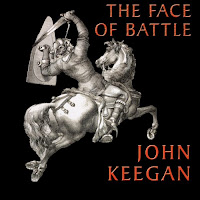
The Face of Battle by John Keegan
One thing I do a lot of these days is listen to audiobooks on subjects that will broaden my horizons as an author. And not only that, since I edit professionally where military situations often crop up, so it's important that I Know All The Things when it comes to the smaller details – like battle. The Face of Battle by John Keegan was included in my Audible subscription, and it was a no-brainer for me to pick it up. It helps, also, that the narrator, Simon Vance, has a wonderful voice. I'm now putting more works that he's read on my TBR list purely because I like him so much.
Keegan's writing takes a little time to get into, but once I got past the introduction, I was accustomed to his diction and the subject matter. The Face of Battle looks primarily at how the experience of battle was for the average soldier – a reality often overlooked or glossed over in historical accounts that tend to glomp together combatants' experiences as if the armies were singular entities rather than units made up of individuals.
How we, as human beings, face the trauma and tribulations of battle and extended warfare, is an undeniably complex subject. How we do battle, too, has changed profoundly over the years, as Keegan explains. While the topic of warfare over the centuries is certainly broad, Keegan picked three famous battles in which he showcased the changes: that being Agincourt (1415 CE); Waterloo (1815 CE); and the Somme (1916 CE).
Once thing that is clear, is that our ways of killing our fellow humans have gone from the personal – featuring one-on-one conflict using blades – to the impersonal, involving ranged artillery bombardment that often lasts for months. How we write about these battles and history matters, for if we lose sight of how things are for the man on the ground, it's far too easy to embellish and gloss over the sheer weight of human misery. Issues such as supply lines, lack of communication, and dealing with injuries are just as important to consider as strategy and final outcomes. We see how commanders were once hands on, moving from site to site in order to maintain efforts, to the fact that those in charge often never set foot at the front – directing troop movements remotely.
Keegan does well to illustrate the often fraught situations combatants find themselves in, giving a deep dive into the conditions in which many brave and often terrified men perished. I'd recommend this classic to anyone who is fascinated by military history or who wishes to gain a broad idea of how battles are enacted – and this is an important resource, I feel, for those who are looking at writing historical or military fiction.
Sunday, July 4, 2021
Origins: The Search for Our Prehistoric Past by Frank HT Rhodes
I was one of those kids who grew up watching way too many National Geographic documentaries at a child, so every once in a while I still love to indulge in content that will not only prove to challenge me, but also broaden my understanding of the natural world. Origins: The Search for Our Prehistoric Past by Frank HT Rhodes, narrated by Derek Perkins, is one such title that, as the the name suggests, digs deep into the origins of life on our planet.
This is an ambitious work, and the periods it covers is vast, but what I really appreciate about it is that it really put into perspective our position as a species when viewing the vast history of life on Earth. Truth be told, our existence as member of the family of great apes is a mere addendum when all is considered. In evolutionary terms, mammals are pretty much latecomers on the planet.
Rhodes not only delves into the history of life on earth, and all the multiple theories and hypotheses lying at the root of our understanding, but he also tells the story of the very early geologists and palaeontologists whose life works contributed to the theories that are currently accepted by the majority of scientists this day. Great care is taken into explaining how the theory of evolution functions, as well as how the taxonomy of living things is executed. It doesn't matter if you know next to nothing or, like me, are an armchair enthusiast – you'll get a wonderful broad overview that acts as a springboard for further study.
To be fair, this is such an enormous topic to cover, but I do think Rhodes does admirably well to paint in broad strokes – especially when it comes to explaining how evolution works. What I appreciated also was the way in which he touched on the reality of extinction, examining the mass extinction-level events or circumstances of the past, as well as reminding readers of the essential ephemeral and somewhat tenuous nature of life.
The only downside to listening to the audiobook is that you don't have ready access to any of the accompanying diagrams or illustrations that you'd find in the printed book, but you can download a handy reference guide as a PDF from the Audible website if you're of a mind to delve deeper.
Saturday, June 12, 2021
Ancient Rome by Thomas R Martin
Monday, May 24, 2021
When Women Ruled the World: Six Queens of Egypt by Kara Cooney
While on one hand, I really enjoyed these profiles of amazing women who took the reins and wielded the power they seized, to varying degrees of success, I did feel as if Cooney's writing erred on the side of being too ideologically possessed at times. She frames the stories of these rulers in modern, feminist terms and ideas of feminine power – through a modern lens – rather than seeing their lives for what they were: products of their time. The sour cherry for me were comparisons to Hillary Clinton's political machinations – a little on the rich side for me, too, with a US-centric flavour that mars the overall impact of the work.
Sunday, February 21, 2021
Orca by Richard Peirce
Anyone who's local to the False Bay coastline will no doubt have a passing familiarity with our local shark cage diving industry that's a huge tourist attraction. In Orca, Richard Peirce, takes a deep dive into the shark cage diving community of Gansbaai in particular, and gives us a glimpse into the complex, interlocking of community and nature, and the difficulties a community faces when they rely heavily on a natural resource that is increasingly under environmental pressure.
The great white sharks of False Bay are known for their population density and also their habit of breaching, when hunting their prey of Cape fur seals. This understandably has resulted in many exciting photographic opportunities in addition to the chance for visitors to get up close and personal in the cages that are submerged at the spots sharks often frequent.
Sleepy little seaside towns like Gansbaai have, over the years, been transformed into mini tourist meccas, with many local operators launching several shark-viewing trips a day. At least that was until the majestic great white sharks vanished. Even more disquieting were the carcasses of mature sharks washing up on beaches in the region. What could be killing the sharks?
Peirce pieces together the mystery, relating how a pair of roving orcas, named Port and Starboard for how their dorsal fins have flopped over, have developed a somewhat grisly taste for great white sharks – particularly their livers – and how they periodically return to prey on a supposedly apex predator.
Naturally, when the great whites vanish, this has a catastrophic effect on the community, which has consequently adapted to these 'droughts'. Fortunately, there are species of shark that have saved the day, for instance the smaller bronze whaler sharks, and tour operators have looked at diversifying the activities that they offer to make up for the times when the great whites are MIA.
What Peirce highlights is the fragility of our ecosystems, and especially our oceans, which are under so much pressure. Is this new behaviour from the orcas? How have humans had an impact on our environment? While there is no convenient closure to this book, it does serve as a cautionary tale for those of us who live close to the ocean and those who rely on it for a livelihood.
Monday, January 11, 2021
Field Guide to Insects of South Africa by Mike Picker, Charles Griffiths and Alan Weaving
If I'd had the Field Guide to Insects of South Africa by Mike Picker, Charles Griffiths and Alan Weaving when I was younger, this may have set me off down yet another rabbit hole in terms of amateur nature conservation. And despite the bewildering array of bugs, beetles, mantids and more that stalk between these pages, Insects is nonetheless presented in such a way that it is a handy guide to quickly identifying most of the creepy-crawlies you may encounter both at home and on your travels. Which is incredibly useful to someone like me who knows next to nothing about them.
For quick reference, simple line drawings on the inside front- and back-covers help you decide whether you're looking at a mayfly or a cricket, after which you can page to the relevant section where clear photos and descriptions, along with range maps help narrow things down further. An introduction gives the basics for those who are new to delving deeper into the subject, not only brushing on the importance of insects and their defining characteristics, but looking at their life history and distribution patterns. A nice touch is also a glance at observing and collecting insects, including methods for capture, but also tips for preserving and presenting them and even photographing them. So this is very much the sort of book I'd gift to budding entomologists.
Due to the vastness of the subject matter, it's simply impossible to for the authors to go into exhaustive detail about every single species out there while still having a book that can be packed in for a trip, but they do touch many species and mention, when applicable, that there are other, similar types creeping about if they don't have their own, discrete entry. This book is absolute gold, and has a permanent spot in my collection. If you love nature or gardening, Field Guide to Insects of South Africa is a must.
Friday, December 4, 2020
Stuarts' Field Guide to the Tracks & Signs of Southern, Central & East African Wildlife
First things first, Stuarts' Field Guide to the Tracks & Signs of Southern, Central & East African Wildlife by Chris and Mathilde Stuart is an enormous book despite the disarming 'field guide' size. Also, if you're an amateur game ranger like me, this book is no doubt going to find its way into your luggage the next time you go on a trip to the country.
While the topic the Stuarts cover in this tome is extremely broad, they do an excellent job of going over the various signs you might encounter if you're out in the veld. Initially when I'd picked up this book I thought that it would just cover tracks, but I was oh so wrong. I forgot at the time all about the fact that one often will encounter not just tracks but also ... yes... poop. And nests, shelters, the remains of prey and other signs of feeding. Or the fact that an elephant or buck might rub against a tree regularly to scratch an itch, or hell, if you're an elephant, just uproot the whole darned tree.
(So now I know that it's porcupines that have been galumphing around on my favourite walk. I saw their poop.)
What I like about this book as well is that it's not just a laundry list of spoor and signs, but rather that it is structured to help you narrow down your options. Is the spoor showing paws or hooves? Are the hooves cloven or non-cloven? You get the idea. Of course it also helps if you have a general knowledge of what sorts of animals are already present in your environment – so I do think this book will be valuable for those who already possess more than just a passing interest in and knowledge of wildlife.
Due to size constraints and the sheer abundance of data that's gone into this book, don't expect detailed information about the critters – that you'll have to look for in other sources. Tracks & Signs focuses primarily on exactly what it says it does, in as much detail as space allows.
Monday, March 30, 2020
Beachcombing in South Africa by Rudy van der Elst
This light, easy-to-read guide gives a very basic overview of what one can expect to find while on the beach, be it items that are from the sea, such as shells, jellyfish or fish, to items that have floated on the tide such as seeds from trees or manmade flotsam and jetsam. In case you were interested, yes, there is a difference between flotsam and jetsam, and you'll find out what that is.
Due to the scope of the book, there isn't space for Van der Elst to go into any great detail about any of the topics, but he does provide a good jumping off point for those wishing to dig deeper (the references and further reading section right at the end will provide loads of content to seek out).
Each section is amply illustrated with informative photos and info panels, that offers a taste of information that will at least lend seekers with some authority when explaining what they've found – especially useful I reckon to parents embarking on a seaside holiday with kiddos. There is some indication of the legalities and protocol to keep in mind when finding certain objects, and what to do when encountering sea mammals and birds in distress. The useful contacts and numbers right at the end is also a nice touch.
All in all, this is a useful book, and if you're one of the lucky sods who has a beach house, get yourself a copy to leave there for those seaside holidays.
Friday, December 13, 2019
The Fishy Smiths: A Biography of JLB and Margaret Smith by Mike Bruton
I'd hazard to say that the husband-and-wife team of JLB and Margaret Smith is nearly as remarkable as Old Four Legs himself. This pair of ichthyologists not only did groundbreaking work in describing the coelacanth but were also instrumental in establishing ichthyology in South Africa.
To say that JLB was a driven man is an understatement. Although he started his career in chemistry, his passion for the taxonomy of fishes, and indeed fishing, led him away from his position as chemistry lecturer at Rhodes University in Grahamstown and took him in another direction entirely.
Margaret was initially set on becoming a medical doctor, but gave all that up when she met and married JLB. She aligned herself with his interests and set herself up as the consummate research assistant and partner – complementing JLB perfectly. Together the pair achieved much more than many scientists could on their own.
They are perhaps also known for the book The Sea Fishes of Southern Africa, which JLB authored and Margaret painted many of the illustrations. This book was considered one of the most comprehensive guides of its time.
JLB himself was a complex man, and most certainly a product of his era – some of his stances on race and politics wouldn't wash in this day and age. However his contribution to the field of ichthyology is undisputed. (Even if he advocated the use of dynamite or poison while collecting his samples!)
Author Mike Bruton writes a compelling biography for JLB and Margaret, giving us a vivid, detailed and warts-and-all account of the lives of these two remarkable individuals. The Fishy Smiths should be of interest to anyone who is fascinated with our natural heritage. I was particularly in awe of Margaret, that she so aligned with her husband's cause and in the end made it her own. I'm not certain I could ever be so accommodating! This book serves as an inspiration to individual excellence.
Friday, November 15, 2019
Cat among the Pigeons by David Muirhead
Cat among the Pigeons by David Muirhead is the quirky, fun kind of book that I'd happily gift to my dad to read. Muirhead's collection of short, humorous musings about assorted species such as killer whale, caracal, elephant, gorilla, gemsbok, and rain frog, among many, offers readers a dip into a veritable bestiary of African beasties.While this book isn't going to have the kind of meat to its bones that will satisfy a serious armchair conservationist, it's still the kind of read that combines facts with myth, and serves up a dish that is both entertaining and informative.
Muirhead's writing is light, fun and easy to get into – and as he suggests, it's the kind of reading you can do before you go to bed, or even if you don't have a huge amount of time and are looking for a short piece to while away a minute or three. Also, illustrator Patricia de Villiers's art provided a quirky counterpoint to the text.