Showing posts with label robin hobb. Show all posts

Monday, June 19, 2017

Assassin's Fate by Robin Hobb

I knew there would be ugly tears at the end of Assassin's Fate. Robin Hobb excels at causing me to break down in ugly tears. There are very few authors who can punch me in the feels the way that she does. It's going to be difficult to write this review without spoilers, but I'm going to give it a stab though at time of writing I'm still feeling quite raw.

Anyone who's been in for the long haul with Robin Hobb will know that the FitzChivalry Farseer books (three trilogies) are part of her larger universe that includes the Liveship books and her related dragon books. It's taken me years, but I've finally caught up with Fitz, the Fool and Nighteyes, whose intertwined fates are complex and often take remarkable turns.

Objectively, this is not the strongest book of the series; at heart it is an extended epilogue. And I understand. Ending a saga with such a perennially popular character like Fitz is *difficult*. There is always the temptation to leave open "happy for now" threads but anyone who knows Hobb's writing will be well aware of the fact that she foreshadows *everything*. And while there are a few red herrings in Assassin's Fate, I was not surprised by the decision she made for the conclusion. It was *right*. I could see it coming a mile off yet I cried so much I had to give my glasses a good wipe afterwards and go wash my face.

I'll say this much: Not many authors can make a novel that is basically an extended sea voyage and rescue exciting, but Robin Hobb succeeds, and it's because of her attention to detail, the examination of the lives of others and their interactions and the smaller conflicts within the greater picture. The story is in its subtleties, and Assassin's Fate is the novel that ties everything together for all the stories that have come before. If Hobb wishes to leave this setting here, that would also be fine and right for me. In fact, it would be a perfect place in all its bittersweetness.

The story itself has a dual nature, part laying to rest of ghosts, part coming of age. Fitz is a man outside of time, who lives with his regrets. And he is tired, and this shows in his interactions with others. Bee represents a fresh current, heir to the incredible stories that have happened before her time, and burdened with being the one who is at the heart of the drama that takes place in the present. This is, as can be understood, a heavy burden to bear yet her trials also serve as a crucible.

I'm not going to go into any further detail, because it's difficult to discuss deeper without spoiling the story. If you've yet to read any of Robin Hobb's books, start with Assassin's Apprentice, book one of the Farseer Trilogy. Then read the Liveship Traders and the Rainwild Chronicles. The Tawny Man trilogy slots in somewhere there too, then finish with the Fitz and the Fool trilogy. You will meet an unforgettable cast of characters, and since I've now read many of the early Fitz books for the second time, I can state with authority as a long-time fan of SFF, that Robin Hobb's stories deserve their place among the classics in the genre, right up there with luminaries like George RR Martin, Mark Lawrence and others who write the kind of fantasy that doesn't shy away from treading on difficult topics with nuance.

Thursday, December 29, 2016

Fool's Quest (The Fitz and the Fool #2) by Robin Hobb

BIG DISCLAIMER: HERE BE SPOILERS. YOU HAVE BEEN WARNED.

Also, if you haven't read the preceding books in the trilogies, none of this might make much sense to you.

I really didn't want to reach the point where I hit the end of what's currently available with Robin Hobb's Fitz and the Fool trilogy, but here we have it, book two. Fool's Quest breaks from all the preceding books in that Hobb gives us a new viewpoint character: that of Bee, Fitz's second (and last) daughter with Molly.

So, if you're resistant to the idea of the novel swapping between the two, be prepared for the shifts in voice. While Fitz is reflective, older and may have lost some of his edge (he is an older man in his fifties, though his body is still under the thrall of that misfiring healing spell), we discover the world anew through Bee, who doesn't have all the threads of the past history at her disposal.

In a way, this is a way for Hobb to inject new life, new uncertainty into the setting. There is only so much we can show from Fitz's point of view and the story needs the freshness of a young, inquiring mind.

Bee is also not an ordinary child, as we discover, and her heritage is firmly intertwined with the Fitz/Fool/Nighteyes triad, though I shall refrain from elaborating too much. Suffice to say that Fitz and the Fool share a relationship that transcends the physical. A carving that Bee examines illustrates this relationship beautifully, and Nighteyes remains present, though not in a tangible form (but also in a way that brought a hard lump to my throat).

Fitz as always exists outside of time. The world outside Withywoods, his estate, has moved on. Power has shifted. Kettricken is no longer the primary power; her sons are coming into their own. Nettle has taken on a prominent role at court and my heart bleeds for the often prickly, awkward relationship she has with her father. Fitz, as always, makes poor decisions, for which he and others later pay the price. He is faced with great sadness, with loss, with change that he himself doesn't quite feel and in that he is quite a tragic character.

There is that Other Thing that is foreshadowed quite heavily in book 1 of this trilogy that plays out to its conclusion (inevitable for those of us who're accustomed to Hobb's clue-laying) that ripped my heart out. Yet in a way this was necessary, as this novel is very much a coming of age story, not only for Bee but also for our Fitz, who with the reappearance of the Fool, is once again cast in his role as Catalyst.

Hobb is not in a hurry with her storytelling. As noted by Mark Lawrence, in his review, "There are very few authors who can get me to tolerate considerable detail spent on clothing, gifts, feasting and just plain organizing stuff. George RR Martin somehow manages it, and so does Robin Hobb. I guess that if you write well enough then anything goes."

To that I can't add anything, except to say that to immerse myself in Hobb's writing is to have a fully tactile experience in another world, down to every last detail, and there are times in my life when this sort of measured, highly textured writing that slowly unfurls is *exactly* what I need to make me feel better about having to face my own grind. And hells, book three can't come fast enough. The waiting is pure torture.

Saturday, December 3, 2016

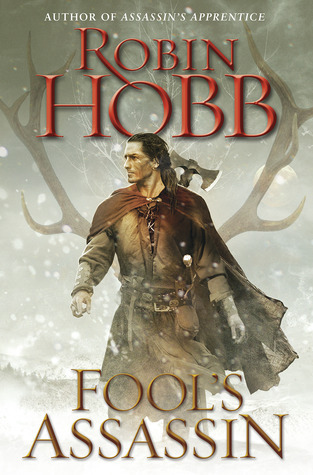
Fool's Assassin (The Fitz and the Fool #1) by Robin Hobb #review

Title: Fool's Assassin (The Fitz and the Fool #1) 
Author: Robin Hobb

Generally when authors return to their settings after many years' absence (either in writing or in years for the characters themselves) it doesn't often bode well for the quality of the story. I'm happy to say this is not the case with this third trilogy in the saga of FitzChivalry Farseer – The Fitz and the Fool. A big problem authors face is that of what new and (often) shocking revelations to offer, and we end up with a huge, whooping mess of "Too Much Awesome" [yes, I'm looking at you, Anne Rice, and your vampires]

That being said, I would most emphatically *not* recommend Fool's Assassin to those who've not read the preceding two trilogies. You'll be in the dark as to so much of the nuance and the backstories. So, if you've not read these other books, you probably shouldn't read the rest of the review. If you love nuanced, textured fantasy, just go read those books then say thank you. You won't get those hours of your life back but you'll be ever the richer for the experience.

SPOILERS! SPOILERS! SPOILERS!


Seriously, don't read any further if you don't want spoilers.


[Deep breath]

My feelings about the later Fitz books are complex. There's a part of me that understands that I'll never be able to recapture that same sense of wonder that I had exploring the world through a younger Fitz's eyes as in the first three books. Nor his more measured, somewhat disillusioned self in the catastrophic occurrences that transpire during the second trilogy. And oh, the heartbreak. The feels are...intense.

Nope, the Fitz we encounter in The Fitz and the Fool is an older man who's now coming to grips with the complex role of being a father figure to his extended family. An existence that should be idyllic is tempered with a growing series of annoyances (this is Hobb at her finest, foreshadowing disasters yet to come which Fitz, true to his style, chooses to ignore to his detriment) that eventually all tie up.

Okay. Most of this book is exposition. I'm not afraid to say it. In a sense, this is Hobb taking a huge breath and reframing her world, and two other central themes are change and loss. He has always hoped (at least in the preceding books) to one day have this life, but sadly for him his past has an uncanny way to grasp hold of his present.

Perhaps the most obvious is the fact that outwardly he has not aged, while Molly, the love of his life, is growing older. (This is due to a healing spell that exceeded far beyond expectations in an earlier instalment). Fitz is a man who exists outside of time. He has lost so much – Nighteyes (though our favourite wolf is very much present in spirit) and, of course, The Fool, who in my eyes is Fitz's other great love). Fitz grapples daily with the fact that his world has changed while he himself has grown more insular perhaps, set in his ways. And he excels at self-isolation, as we have already discovered.

This novel doesn't have a huge, earth-shaking plot, but it is certainly gripping in the sense that it sets up events that are important in the future even if the pace crawls along (and I certainly say that you read this novel to have a slice of Fitz's life and to understand what motivates him in what follows). And there is The Thing that happens. It is an awesome Thing. Canny readers will facepalm that Fitz is so blitheringly unaware of The Thing as it comes to fruition, but there's that little bit of wonder that you will feel when you see it unfold, and oh, Molly, she is a joy. Just to have one book devoted to the love between Fitz and Molly is a reward in itself. Fitz might not set out to save the world (just yet) but this bittersweet novel will introduce you to the players who'll be important in what's to come. I missed The Fool's presence terribly with this book #1 but a little anticipation never did anyone any harm.

Sunday, November 6, 2016

The Tawny Man Trilogy by Robin Hobb #review

The Tawny Man Trilogy by Robin Hobb
(Fool's Errand, The Golden Fool, Fool's Fate)

Where do I even begin? This year I credit my survival as being partially due to good friends and Robin Hobb's books, and The Tawny Man trilogy was key to my emotional and psychological well-being.

FitzChivalry Farseer is by far one of my favourite characters. Life has handed him a raw deal. Every time you think he's at the top of his game, or that things are finally going right for him, the metaphorical rug gets pulled out from beneath his feet.

We learn in this series more about his special relationship with the Fool, and how the two of them are responsible for setting the world to rights. You'd think that Fitz and Nighteyes would slip quietly into history after their high adventure and derring-do to wake dragons and save the Six Duchies from the Red Ship Raiders and a mad king. But no.

This is not the case.

Though Fitz considers himself old, and Nighteyes is even more so a venerable wolf who has long outlived his natural years, the two are dragged into fresh misadventure when they are sent to discover the fate of Queen Kettricken's son. As much as Fitz loathes politics and intrigue, he truly comes alive when he is thrust into the midst of it.

We learn much of how the Wit magic works, as not only do we discover a conspiracy of the Witted to seize power, but there is fresh concern over the fact that the missing Prince Dutiful is betrothed to an Outislander princess.

And there is what I call That Thing That Happens that astute readers would have understood implicitly is coming, is unavoidable, but Hobb sneaks it up on readers with such flair, with such awful dignity and precision that I had to put the book down and have a good, ugly cry for a quarter of an hour. Then I reread that scene again and had to go wash my face. The only other authors who've succeed in reducing me to a blubbering wreck are JRR Tolkien (I cry every time the elves return to the West) and of course Richard Adams's Watership Down.

Fitz and the Fool go on to have hectic adventures, travelling far afield on the trail of, yes... Dragons. While I do feel the pace does flag at times, and Hobb certainly (and rightfully so) is in no hurry to tell the tale, those hankering after fast-paced action may whinge a bit. (And yes, how I loathe those types of readers). This is a story where you let go and immerse for individual scenes, for the descriptions for the incredibly detailed cultural heritage she has constructed. Hobb's rich world-building, her well-realised, three-dimensional characters make this an unforgettable experience. And, of course, every exquisite detail. Pay attention when you read, because often it's the smallest, seemingly inconsequential details that later have earth-shattering ramifications.

This is a story about love, and what people are willing to do for the ones who are dear to them. It's about the secrets that turn around and bite them later; the sacrifices people make. Central to this is the triad of Fitz/The Fool/Nighteyes, and how the three are but parts of one complex character, or rather expressions of the same – a composite that has grown together. And yes, there are times when Hobb rips out your heart, just as she does with Fitz, but then she puts it back together again in the most unexpected ways to make you gasp and place a hand on your chest.

If ever there is an author who inspires me to do better as an author, it's Hobb. Sometimes authors don't stand the test of time; sometimes you return to their writing years later only to be disappointed horribly, (um hello, David Eddings). Not so with Hobb.

Monday, September 5, 2016

Assassin's Quest (Farseer Trilogy, #3) by Robin Hobb

Title: Assassin's Quest (Farseer Trilogy, #3) 
Author: Robin Hobb
Publisher: Harper Voyager, Kindle edition 2007

The thing with the Farseer books is that they go dark —far darker than I'd ever had fantasy go when I first seriously started reading the genre. We join Fitz at his lowest ebb. He's lost everything, the woman he loves, his position at court. He'd be a hunted criminal if it weren't for the fact that everyone believes that he's dead. As it is, he's known as the Witted Bastard, and has become something of a bogeyman used to frighten children. Yeah, so that totally sucks.

Free for the first time in his life to act with agency, Fitz chooses to avenge himself on the one who's responsible for creating the hell that has become his life – Regal, now king of the Six Duchies. And yet he's not free, for the duty laid upon him by his uncle Verity draws him to the Mountain Kingdom to aid the true heir in his mission to free the kingdom from the marauding Red Ship Raiders.

Hobb goes further to explore the relationship between Fitz and his wolf Nighteyes, in all its beautiful subtlety. Her deft strokes expand on the nature of the relationship with the enigmatic Fool, who will always be present, helping and, sometimes, hindering. Ketricken and Fitz also have a special relationship that is deep and abiding – and I dare say a true bond.

This is my second read through the book, and as expected, I missed a lot the first time and though I recalled the gist of what happens, there is so much layering to rediscover that it felt as if I were reading the story again for the first time. We are presented with the ancient mysteries of the Elderlings, the dragons, the lost magic of the stones. Our heroes sift through the ashes of a fallen civilisation, hardly understanding the artefacts that they uncover. 

As always, Fitz's self-talk is heavy; he is at the end of the day his own worst enemy and he remains perhaps one of the most enduring and endearing fantasy characters I've had the pleasure of getting to know.

The Farseer books reward patient readers. I've heard folks complain that things take a long time to unfold, but I will keep saying this: nothing Hobb puts in her story goes to waste. Pay attention to every detail because, no matter how inconsequential it seems, it will invariably play an important role later.

I cannot underscore enough what an important work this is in the collective oeuvre of modern fantasy. Hobb deserves all the honours she receives for her immense contribution to this genre, and I stand forever humbled in her shadow.

Sunday, July 31, 2016

Royal Assassin (Farseer Trilogy #2)

Title: Royal Assassin (Farseer Trilogy #2)
Author: Robin Hobb
Publisher: Voyager, 1997

I lose no time telling folks how much I love Robin Hobb's FitzChivalry stories, and this current review represents my second read through of Royal Assassin. Unfortunately, I'd let time slip between book 1 and 2, so I had to scramble a bit to pick up the threads – and this is most certainly a series that I recommend reading back to back. This is due to the huge cast of characters in addition to the multiple, nuanced plot threads.

We resume with Fitz in the Mountain Kingdom, after he has foiled a plot instigated by his half-uncle Prince Regal, whom we've all come to love to hate by now. Months pass before he is well enough to travel back to Buckkeep, and in that time he suffers seizures. He really has lost much confidence.

He returns to a castle where King Shrewd is ill, and it's clear that Regal is machinating to take power (and ruin the kingdoms while he's at it). Prince Verity is tied up trying to protect the duchies from the Red Ship Raiders and, if that's not enough, the woman Fitz loves now works for Patience – his biological father's widow. Plainly put, it's a tangled mess, and Fitz's decisions don't always work out for the best.

We learn more of Fitz's Wit magic in his relationship with the wolf Nighteyes, whom he rescues from a trapper – and to me, this symbiotic relationship is one of the most beautiful friendships I've ever encountered in the written word. Hobb understands her subjects, be they people or animal.

Fitz suffers terribly, that is all I will say for fear of spoiling the story. By the end of the book, he really has gone through a crucible – especially since Prince Verity is no longer there to protect him, as he's gone haring off hunting for the fabled Elderlings to help against the raiders. Hobb offers potential twists that lulled me into expecting one outcome, only to have my expectations dashed as the story plunges ever more into yet another nadir. So far as the Fitz stories go, this one is perhaps the bleakest. And yet it is not without a glimmer of hope, and the ending is just perfect.

My thoughts on having reread are that I'd missed a lot of the nuance when I'd read this when I was younger. Hobb's staggering ability to perceive the hearts of her characters blows me out of the water. Even Regal's motivations are understandable. He's not a one-dimensional Disney-esque villain but one would almost wish that twisted creature that he is, it would be possible to redeem him.

Those who're fiending after fast-paced, action-packed adventures had best move on. As always, Hobb's writing rewards the patient reader who revels in a slowly unfolding epic masterpiece. Not a single bit of information or action is without some sort of impact later on in the story. There was no saggy middle-book syndrome with this installment.


Sunday, May 29, 2016

Assassin's Apprentice (Farseer Trilogy #1) by Robin Hobb #review

Title: Assassin's Apprentice (Farseer Trilogy #1)
Author: Robin Hobb
Publisher: Voyager, 1996

The first time I read Assassin's Apprentice must've been not long after the book first came out. I took the book out at the library and fair gobbled it down, along with the other books in the trilogy. To put it mildly, Hobb's writing keeps me up way past my bedtime. There are very few authors who can successfully manage that feat.

Yet even though I'd read the first three, I was aware that she'd written not only a second, but was busy with a third trilogy all featuring my dearly beloved Fitz and his friends Nighteyes the wolf and the enigmatic Fool. I simply had to revisit the setting, which meant I wanted to dip into the first trilogy again. Boy oh boy, I felt like I was stepping into that world with fresh eyes, and it was just as an emotive journey as it was before.

In a nutshell (and without giving too much away) this is a story about a young boy who's the bastard son of a king-in-waiting, who is trained to be a royal assassin, to do the king's "quiet work". Of course the events that transpire and the characters one encounters along the way are far more varied and unexpected. This is one of those books where you put your life on hold and live Fitz's life with him as he grows up, navigates the complexities of life at court, which includes a murderous uncle who's eyeing the throne though he's not quite next in line in the succession. To make matters even more pressing, their kingdom is under assault by seaborne raiders – the Outislanders. Fitz never knows a moment of true peace.

Fitz is not only an assassin, but he's also gifted (or cursed, depending on how you look at it) with two forms of magic – the Skill (which allows him to influence men's minds and communicate telepathically) and the Wit (which allows him to communicate and bond with an animal). The former is a magic practised mainly by the reining Farseers and the other is a reviled art that, if he's discovered to be in possession of it, will mean his death.

What makes this world for me is the how Hobb populates it with three-dimensional, authentic (and often quirky) characters whose whose motivations often place them at odds with each other. How the hell she even manages to keep all their timelines straight is absolutely stupefying, because every small clue, *every* detail she writes in, is often vital to the rest of the tale.

Unforgettable characters such as Chade, King Shrewd's older half-brother and master assassin; Burrich the stablemaster, who raises Fitz; Molly Chandler, the secret love of Fitz's heart; the Fool; Lady Patience... I fell in love with all of them, all over again, and getting to know them again made them feel like old, favourite friends.

For those looking for an insta-epic with clearly defined plot and HEA, this might not be the book for you. The storyline feels like real life – messy, inconvenient. Fitz makes many decisions that he'll later regret. There are times when you will want to yell at him to either do or do not ... Oh, and the consequences... Every action has its consequences, and Hobb *doesn't* pull her punches.

The world building is detailed, highly textured and yet again, you feel as if you're *in* the story as opposed to skimming through. I am reminded quite solidly, that this is one of those books that I will recommend to those wishing to get into fantasy for the first time, and that Robin Hobb is a master wordsmith who is partially responsible for having inspired me to tread this path of fantasy author myself. Though I'd read this book before, I feel I gained a lot more detail (and a greater sense of awe at Hobb's skill) the second time round. Who knows, in a decade or so, I'll do it all again.

Monday, July 7, 2014

Assassin's Apprentice (The Farseer Trilogy #1) by Robin Hobb #review

Title: Assassin's Apprentice (The Farseer Trilogy #1)
Author: Robin Hobb

Robin Hobb's The Farseer Trilogy numbers among the epic fantasy reads that I always intended to read again. Having read Assassin's Apprentice again, it's clear why her books are considered classics that you will find at almost every good bookstore.

What starts with the almost standard trope of the boy hero with royal parentage, is quickly subverted. Boy or Fitz as he is later known begins life as the unwanted, unexpected son of king-in-waiting Chivalry, and grows up in the stables then is later apprenticed to the assassin Chade.

He was born with the Wit, the ability to touch the minds of other living things, but if anyone were to discover this ability, he would certainly be put to death.

The Six Duchies face an external threat from the Viking-like Red Ship Raiders, who devastate coastal settlements and leave survivors "forged" (magically violated and devoid of all empathy). Yet from the inside, there is strife. King Shrewd's son from his second marriage, Regal, has pretensions to the throne, and bears Fitz little love.

Hobb has populated this saga with a rich cast of fascinating, diverse characters. Though the story is slow paced it is richly textured and it is all too easy to lose on self in the world she has created. I suspect this novel would have been released under the YA banner had it been written now, but Fitz comes to readers with a surprisingly mature voice.

He really has a difficult time and his personality is such that readers can see that he has so much to offer others if only he had the opportunity to share his love. Due to circumstances he is a lonely child, however, and makes do with the scraps he is offered. He experiences much loss and cruelty yet he remains steadfast to his king. This is the redeeming aspect of a character some might find cause to despise because of his vocation.

Hobb has it all in her writing: solid world building, ancient mystery, unforgettable characters, high adventure and enough courtly intrigue to give old GRRM a run for his money. I am looking forward to reading the rest in this series again. At least this time half the books won't be missing courtesy of our sorry library system.